IMPORTANT: If this newsletter is not displayed correctly and you can´t open the links,
please click here.
Please note: The display may vary depending on the browser you are using.
Platzhalter

IScO Newsletter January 2025

Platzhalter

Dear Reader,

We are delighted to welcome Song Utz as the new Head of the International Scholars and Welcome Office (IScO). Shaped by her own international academic journey — from growing up in a family of pioneering Chinese visiting scholars to studying in the U.S. and later leading the Faculty International Office at the University of Southampton — she brings deep personal insight into what it means to cross cultures in pursuit of knowledge.

With more than 25 years of experience in international business and higher education, Song sees this role as an opportunity to “pay it forward.” Her international experience, including time as the family of a visiting scholar, at Georgetown University, the University of Virginia, Universität Freiburg, the University of California Santa Barbara, the University of Southampton, and KIT has strengthened her belief in the power of a strong welcoming culture.

At IScO, Song is committed to enhancing KIT’s support for international researchers — providing a home base for visiting scholars, comprehensive services for guests and hosts, and meaningful funding opportunities that enable global mobility. She looks forward to deepening partnerships across KIT and beyond.

She warmly invites the community to the new event series Good Morning, Karlsruhe, offering international academics a personal point of contact at KIT, opportunities to ask questions, receive orientation, and connect with peers in an informal setting. More information is available below.

Platzhalter

New Year, New Rules: January Updates

January is a month of fresh starts and, in Germany, a month when many everyday rules and thresholds reset. Several nationwide changes take effect for 2026. The basic tax free allowance rises, families will see higher Kindergeld, commuters can claim 38 cents per kilometre from the very first kilometre, and the VAT rate on food served in restaurants drops to 7 percent. The statutory minimum wage also increases to 13.90 euros per hour, and the Deutschland Ticket now costs 63 euros per month. For parents, it is also worth noting that eligibility for Elterngeld is limited if taxable income is above 175,000 euros.

Here in Karlsruhe, January also brings a few local updates to keep on your radar, including higher Kita fees from January 1 and a new rule that fines people for feeding certain wild animals. If you are looking for winter activities, the Kunstmuseum Karlsruhe climbing wall is open on Friday afternoons, and there are a couple of community dates worth noting, including Offene Pforte registration by January 16 and Pfennigbasar donation drop off from January 29 to 31, ahead of the flea market in early February.

With so many news for this coming winterseason, there is plenty to explore in this newsletter.You’ll find updates on upcoming IScO events, KIT news and announcements, and external news that could be of interest to you, including exciting funding opportunities. Plus, we’ve gathered the latest calls for proposals that might just spark your next project. Whether you're looking for new collaboration opportunities or staying up-to-date with cultural initiatives, there’s something for everyone!

Stay curious and take care!

Platzhalter

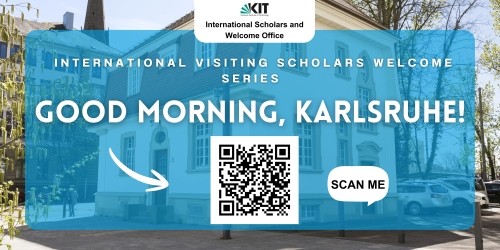
Good Morning, Karlsruhe 


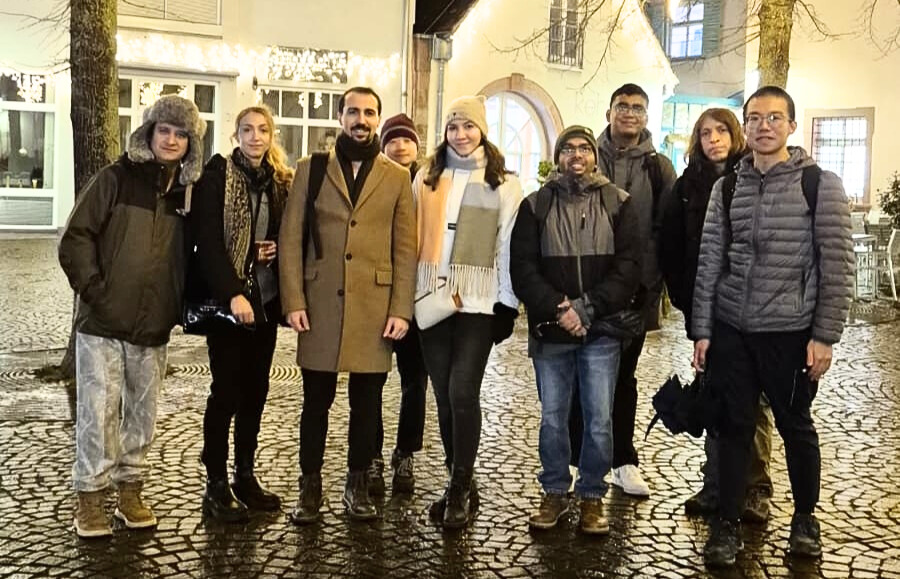
Good Morning, Karlsruhe is a new welcome series by the International Scholars and Welcome Office (IScO) for international academics and researchers at KIT. Meet the IScO team, ask questions, and connect with other international scholars in an informal setting with light refreshments. Launch event: January 26, 2026.
Platzhalter

IScO´s Excursion: A glimpse into the history - Hotel Silber as the Headquarter of the Nazi Secret State Police

Join IScO for a guided visit to Hotel Silber in Stuttgart, a place of remembrance and exhibition on policing, the Gestapo and persecution. Saturday, February 21, 2026, we will attend the 1.5 hour guided tour “Police and Genocide in Europe” starting at 11:00 AM.

Platzhalter

IScO´s Excursion: Where should we go next?


We’re currently planning our next IScO excursion for the upcoming months—and we want to hear your ideas! The destination should be within two hours by regional train from Karlsruhe, reasonably priced (no ICE or long-distance trains), and suitable for a relaxed and safe group activity.

Overview

Excursions and News from IScO

Good Morning, Karlsruhe

What?
Good Morning, Karlsruhe is a new welcome series by the International Scholars and Welcome Office (IScO). It offers international academics and researchers a warm, personal point of contact at KIT and will be hosted every other week. Meet the IScO team in person, ask questions, get orientation on institutional and practical matters, and connect with fellow international scholars in an informal and welcoming setting. Light refreshments will be provided. Please note that photos may be taken for communication and documentation purposes. If you prefer not to be photographed, please inform the organizers in advance.

Goals of the events 
  • Form a foundational pillar of a strong international welcoming culture at KIT
  • Serve as an approachable and reliable reference point between international scholars and their new academic and social environment.
  • Appreciate the diverse cultural backgrounds and experiences of international visitors.

Target group
Newly arrived international researchers and visitors at KIT. International academics who are already at KIT are also welcome to join.

Where?
Library, Building 30.51, Lecture Hall, 3rd Floor, New Building

When?
Monday, January 26, 2026, 9:00 to 11:00 AM

Registration: Please register for the event on the 26th of January online

Two more events are scheduled in February

  • Date and Time: Monday, February 9, 2026 and Monday, February 23, 2026. Time will be announced on the website.
  • Venue: KIT Campus South, Building 50.25, Room 005 (ground floor - turn left and then go around the corner), Adenauerring 2, 76131 Karlsruhe.
  • Format: In person.
  • Registration: Registration required. The registration link will be updated on the website soon.

IScO´s Excursion: A glimpse into the history - Hotel Silber as the Headquarter of the Nazi Secret State Police

Join IScO for a guided visit to Hotel Silber in Stuttgart, a place of remembrance with a permanent exhibition on the history of policing, the Gestapo and persecution. The building was already used as a police site during the Weimar Republic. Under National Socialism, it became a key location connected to the Gestapo, from which surveillance, repression and persecution were coordinated, affecting many people in Württemberg and Hohenzollern and beyond. After 1945, the building continued to be used by the police, and its later history also raises complex questions about continuity, accountability and remembrance.

Today, the exhibition traces both breaks and continuities from the Weimar Republic through the Nazi dictatorship and into the post war period. Using documents, photographs and media stations, it examines how democratic institutions could be undermined so rapidly, how authorities and individuals became involved in state violence, and how the role and self understanding of the police shifted across dictatorship and democracy. The exhibition also preserves personal traces from the site, including inscriptions left by prisoners and objects that reflect the repression of everyday life and youth culture at the time.

As part of our visit, we will take part in a 1.5 hour guided tour titled Police and Genocide in Europe. The tour starts at 1 PM and looks at the role of the Württemberg Gestapo and Criminal Police in the persecution and deportation of Jews as well as Sinti and Roma from Württemberg and Hohenzollern, and at how staff connected to Hotel Silber were deployed in other parts of Europe. It also explores individual responsibilities and the consequences for those who were targeted. The tour is designed to support learning and reflection in a respectful setting.

After the tour, we can head to lunch together in Stuttgart if you’d like, and decide on a place once we meet. If you prefer, you can also take the train back to Karlsruhe after the guided tour.

  • Date: Saturday, February 21, 2026
  • Meeting time: 11:00 AM at the main train station in Karlsruhe in front of McDonalds. We will take the RE1 train at 11:30 AM to Stuttgart main station. Then we will walk for 15 minutes to the Hotel Silber.
  • Venue: Hotel Silber, Stuttgart
  • Registration: Registration required until February 16, 2026. Please also register any friends, colleagues or children that you plan to bring along.
  • Cost: €10 per person. A train ticket is not included. The ticket currently costs €17.10. If you have a Deutschlandticket, you can use it (so no extra ticket is needed), as the train we will take is covered by the Deutschlandticket.

If questions arise, please write us an e-mail
Please feel free to share this offer among your network!

IScO´s Excursion: Where should we go in 2026?

We’re currently planning our next IScO excursion for the upcoming months—and we want to hear your ideas! The destination should be within two hours by regional train from Karlsruhe, reasonably priced (no ICE or long-distance trains), and suitable for a relaxed and safe group activity.

An IScO excursion is not just about sightseeing—it’s an opportunity to learn more about German culture, society, and history, to experience new places together with fellow international researchers, and to take a short break from academic life.

Possible ideas could include:

  •   A cultural day in Mannheim, visiting the Baroque palace, the Reiss-Engelhorn-Museums, and the vibrant Jungbusch quarter.  

  • hike through the Black Forest, starting from Bad Herrenalb or Bühl—easy and scenic routes only, no risky or extreme activities.

  • museum in Speyer, combining regional history, sustainability topics, and time to explore the vibrant student town.

The trip will take place outside the university.

Have an idea? Let us know which places you’d love to explore. We’re looking forward to your suggestions—and maybe we’ll turn one of them into our next excursion!

If questions arise, please write us an e-mail

News and Announcements from KIT

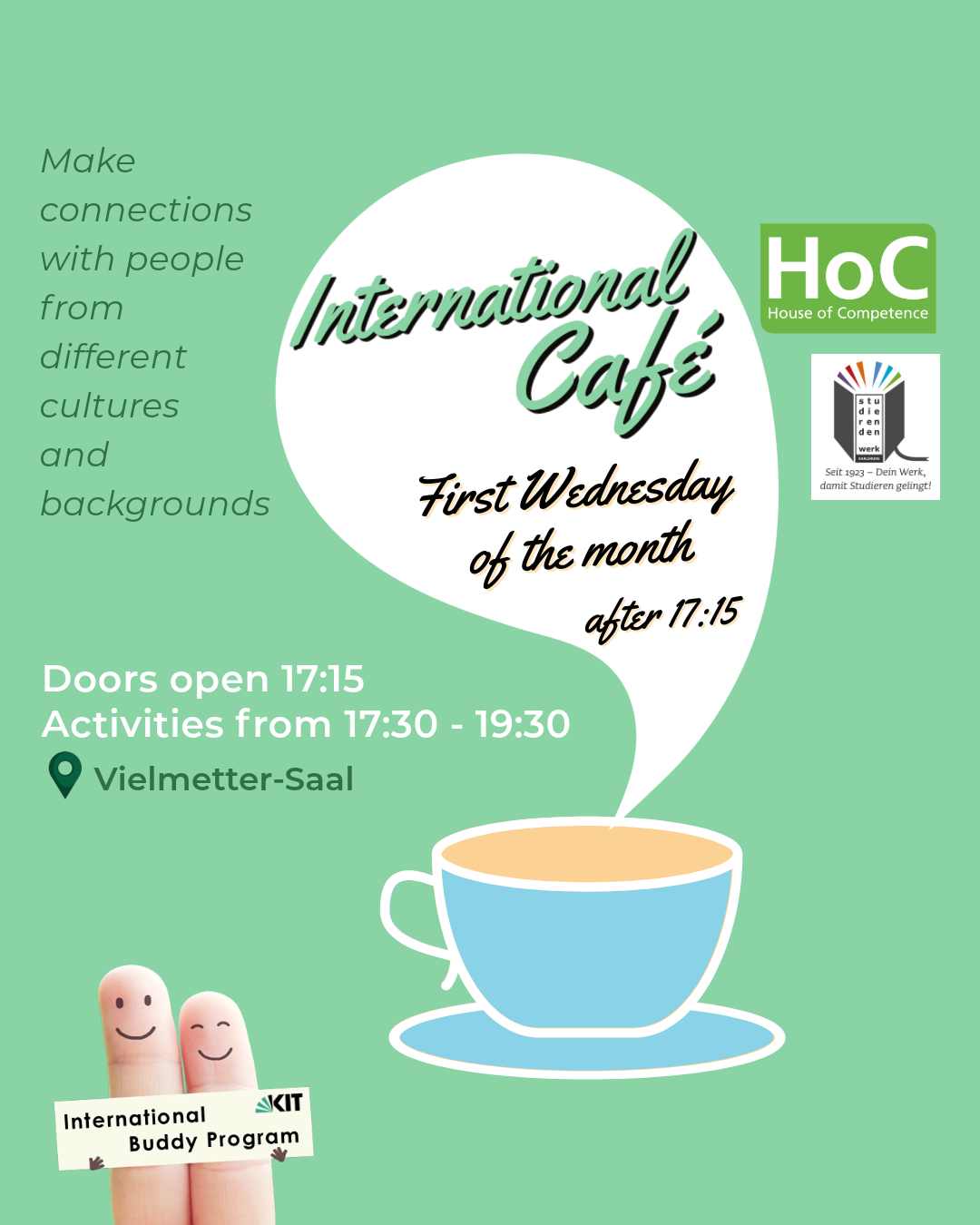
International Café plus BAOS (Buddy Activity Organizing Session)

Take a break from studying and join the International Café for a relaxed evening to clear your head, meet new people, enjoy a drink, and connect through intercultural exchange. The event is open to all students interested in meeting others across cultures. Before the café starts, you are also welcome to drop by the BAOS Buddy Activity Organizing Session to continue working on your activity planning, meet other buddies to plan activities together, ask the Buddy Team questions, and get inspired by new ideas. Studierendenwerk and the House of Competence support the event and will be present with information tables about KIT support services.

  • Date and Time: Wednesday, February 4, 2026. 4:30 PM BAOS round table. 5:15 PM doors open. 5:30 PM drinks and activities. 7:30 PM end. Recurs every first Wednesday of the month.
  • Venue: Vielmetter Saal (Studentenhaus, Gebäude 01.12, Adenauerring 7, 76131 Karlsruhe (follow the signs).
  • Format: In person.
  • Participation: Registration required online. No walk ins due to limited capacity (max. 50). Please deregister if you cannot attend. Buddy Points can be collected. With 10 or more Buddy Points you can receive a document for social engagement.

If you have further questions, please contact the Buddy Team via e-mail. Follow @buddyprogramm_kit on Instagram for updates.


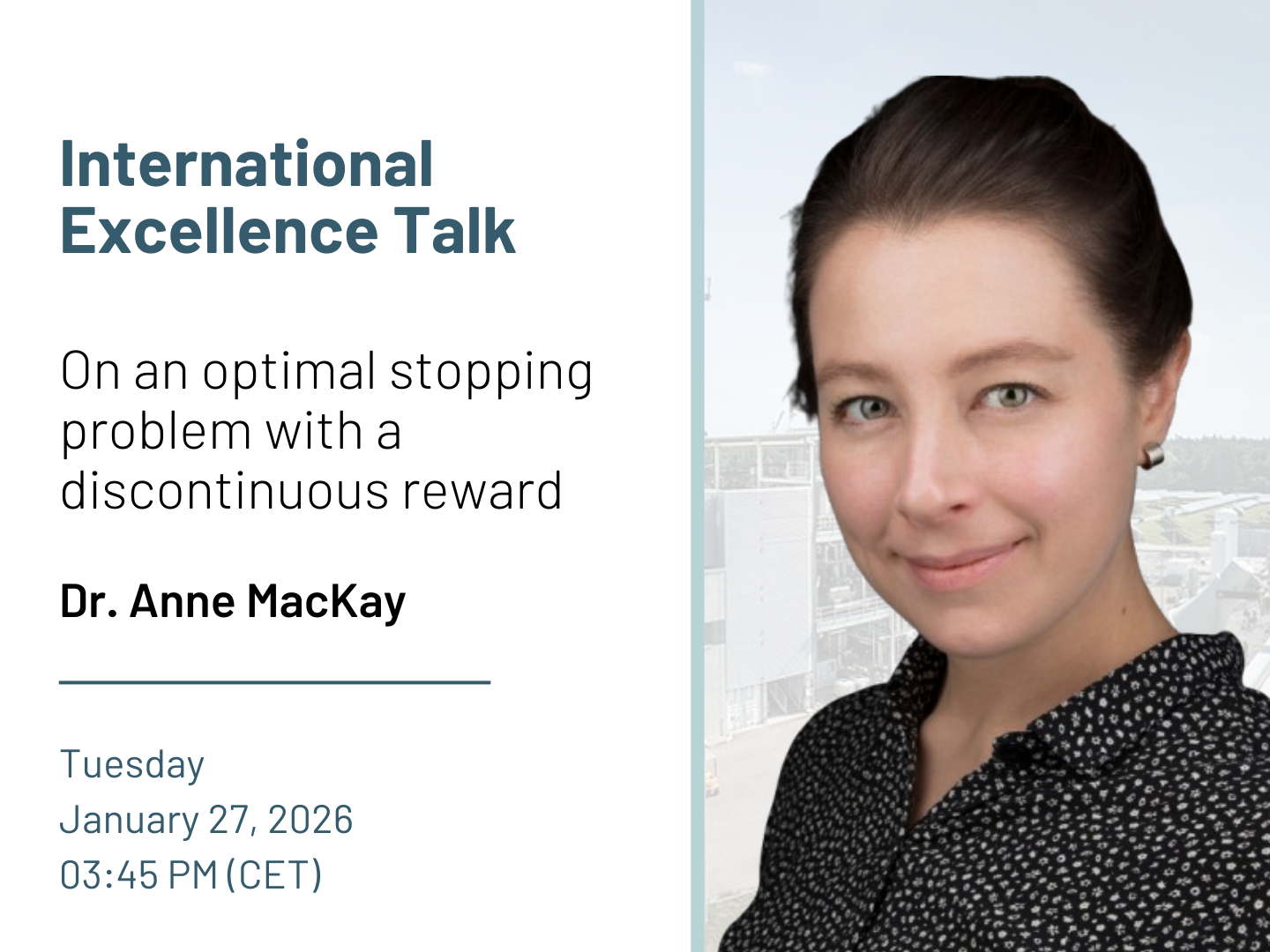
International Excellence Talk with Dr. Anne MacCay, Université de Sherbrooke, Canada

On an optimal stopping problem with a discontinuous reward

We are pleased to invite you to an International Excellence Talk featuring Dr. Anne MacKay, International Excellence Fellow of KIT 2026 and Associate Professor in the Departments of Mathematics and Finance at Université de Sherbrooke, Canada. Dr. MacKay’s work lies at the intersection of actuarial science and mathematical finance, with a particular focus on optimal stopping and control problems in hybrid insurance products, numerical and simulation methods in finance, and the application of quantum computing to problems in financial mathematics.

  • Date and Time: Tuesday, January 27, 2026, 3:45 PM (CET)
  • Venue: Seminar Room SR 2.059 SR 1.067. (Building 20.30), Englerstraße 2, 76131 Karlsruhe
  • Format: Hybrid – in person & via Zoom (with registration)
  • Participation: Please register in advance online. Attendance is possible in person or via Zoom.

If you have further questions, please contact the Team of the International Excellence Talk via e-mail. 

KIT Internal Call: Bertha Benz Prize 2026

What?
The Daimler and Benz Foundation awards the Bertha Benz Prize to honour the achievements of Bertha Benz and to recognise young female engineers with outstanding dissertations. Scientific institutions can nominate candidates whose dissertation findings create added value for society. At KIT, the Karlsruhe House of Young Scientists (KHYS) coordinates the internal pre selection and nomination process. KIT can nominate up to three candidates.

Where?
KIT, internal nomination process coordinated by KHYS (digital submission by email).

When?
Nomination reference date: March 1, 2026 (doctoral certificate date applies).

Target group
Young female engineers at KIT with an excellent dissertation (Dr.-Ing.).

Funding
Prize money: EUR 15,000 (please note that prize money may be subject to income tax and social security contributions).

Additional requirements / selection criteria
Eligibility requirements include:

  • Doctorate (Dr.-Ing.) awarded no more than one year before March 1, 2026 (based on the doctoral certificate date)
  • Dissertation graded “magna cum laude” or “summa cum laude”
  • Doctoral researchers cannot apply directly to the Daimler and Benz Foundation (applications go through the KIT internal selection)

Notes for the KIT process:

  • Only complete applications submitted on time and in proper form will be considered
  • Each document should clearly state what it is and who created it
  • Recommendation letters must explicitly refer to the Bertha Benz Prize
  • A preliminary confirmation can be submitted first, but the doctoral certificate is required in case of nomination no later than February 26, 2026, 5:00 pm
  • The Excel sheet must be submitted in English (other documents may be in German or English)

Submission
Submit the required documents exclusively in digital form, as individual files (not merged), named: Family name_Document name_Bertha Benz Prize 2026

Required documents

  • Doctoral certificate (or preliminary confirmation)
  • Summary of main research results (max. 3 pages)
  • Tabular CV
  • List of publications
  • Copies of examination certificates (intermediate diploma or bachelor, diploma or master)
  • Two letters of recommendation
  • Completed Excel spreadsheet (in English)

Send by email to KHYS by January 26, 2026.

KIT internal deadline: January 26, 2026

If you have further questions, please contact the Karlsruhe House of Young Scientists (KHYS) via e-mail. 

Call for Applications: FA(ST)2Africa Mobility Scholarships – internal KIT funding program within the strategy fund project

What?
FA(ST)2Africa is a strategic initiative of the Karlsruhe Institute of Technology (KIT) that aims to strengthen international collaboration with partner institutions in Sub-Saharan Africa in the fields of research, education, and innovation. The project supports the development of long-term, equitable, and impactful partnerships between KIT and African institutions.

The FA(ST)2Africa Mobility Scholarships provide funding for research and cooperation stays at KIT. Applications are welcomed from both excellent researchers (length of the stay one to three months) with the aim to initiate sustainable collaborations – such as joint publications, pilot projects, or new partnership activities and university staff (length of the stay one to two weeks) engaged in international cooperation interested in fostering inter-institutional strategic cooperation. 

Who can apply?
Applicants must hold a PhD or equivalent qualification, have a strong academic or cooperation-focused profile, and have lived and worked in a Sub-Saharan African country for at least five years. The administrative staff must be in a unit that deals with the development or support of partnerships with international institutions. Both target groups must not hold a permanent position in Germany.

Who can submit applications?
Applications must be submitted in collaboration with a KIT host who is part of the FA(ST)2Africa project. Individual applications without a KIT host will not be considered.

Funding duration: 1 to 3 months

Deadline: February 16, 2026

If you have any questions, please contact Dr. Justine Nyarige or Dr. Jörg Helmschrot via e-mail. 

E-Learning Courses: FIT-Career Modules

Expand your academic and professional skill set with the ongoing FIT-Career modules offered by Karlsruhe House of Young Scientists (KHYS). The modules are designed specifically for doctoral researchers and postdocs. These workshops offer valuable insights into publishing, science communication, industry, and leadership.

Available Courses: 

Module: Getting Published
Language: English

Module:
Basics of Science Communication
Language: German and English

Module: Conferences, Presenting and Networking. Communicating Your Research with Impact
Language: English

Module: Short-Cuts to Industry: Initial Insights into Communication
(including Moderating, Negotiations, Storytelling etc.)
Language: German and English

Module: Short-Cuts to Industry: Initial Insights into Management Methods
(including Project Managing, Design Thinking etc.)
Language: German and English

Module: Short-Cuts to Industry: Initial Insights into Leadership
(including New to the Leadership Role, Giving Feedback, Team Development etc.)
Language: German and English


Learn more about the E-Learning Courses of the KHYS.  

Aspirant Grant (Doctoral Researcher/Postdoc) by Karlsruhe House of Young Scientists (KHYS) 

Asprirant Grant (Doc/Postdoc) enables KIT professors and research group leaders to invite promising scientists who are interested in doing research at KIT as a doctorate researcher/postdoc in the near future to spend one month on-site. During the visit, both parties receive the chance to get to know each other and to discuss the possibility of doing a doctorate/postdoc at KIT. The funding measure is part of the KHYS Postdoc Office and is sponsored by the Initiative and Networking Fund of the Helmholtz Association.

Target group: KIT professors and research group leaders

Funding: KHYS will cover the travel and accommodation expenses for the aspirant’s stay

Deadline: Applications for both measures may be handed in anytime as long as funds are available.

Contact: Denisa Kičmerová (KHYS)

Please feel free to share this offer among your network!

External News and Announcements

Events in Karlsruhe

Do you want to get in touch with other English Speaking people?:
  • The American Library has regular events in English for kids and adults.
    For adults: Poetry?Please! (Jan 27).
    For kids and teens: Storytime in English for Kids 3 to 5 (Jan 28), 
  • The Karlsruhe Toastmasters (Website only available in German) meet every 1st, 3rd and 5th Monday of the month from 7:15 to 9:15 PM to practice public speaking in English with friendly, relaxed support from speakers from around 
    the world. 
Do you want to improve your German?:
What events are coming up in Karlsruhe?:
  • Until January 25Ice Skating in front of the Karlsruhe Palace.
  • January 31Royal Tea Time at the American Library. Join us for an afternoon of tea, scones etc. and listen to our special guest, author Elisa Jakob, relates stories about the Victorian Era and how afternoon tea became so popular. Space is limited; registration is required by January 27th. Admission free. Donations are always cheerfully accepted.
  • February 1Open House im Hallenbau KA. The annual open house at ZKM, Kunstmuseum Karlsruhe (formerly Städtische Galerie), Staatlische Kunsthalle and Hochschule für Gestaltung from 11 am to 6 PM. Free. Save the date!
  • February 5 – 8art Karlsruhe. A very popular art market — classic to modern to contemporary at the Karlsruhe trade center. Most of the art works are for sale. Wear comfortable shoes and take breaks to avoid visual overload. Admission fee charged.
  • February 5art Karlsruhe party in the Hallenbau of ZKM starting at 9 PM. Free entry.

Congress Travel Program by DAAD 

With funding from the Federal Foreign Office, the program promotes active participation in international scientific congresses and conferences abroad (in person and online). Active participation is encouraged. Active participation is defined as the presentation of one's own scientific contribution (poster, lecture or panel).

Target group: Postdoctoral researchers and doctoral candidates. 

Scholarship benefits:
Depending on the travel distance, you can choose from four categories of funding with different funding benefits: 

  • Online participation
  • Presence short distance (up to 600 km as the crow flies, excluding the United Kingdom)
  • Presence medium distance (601 - 3,700 km as the crow flies, plus the United Kingdom)
  • Long-haul presence (from 3,700 km as the crow flies)
These funding categories are designed to make it easier for you to participate in a climate-friendly congress.

Helmholtz Associate Postdoc Network (HAPN)

The network warmly invites all Helmholtz postdocs to become active members of HAPN.

Working Group 1 Communications – Responsible for fostering open communication within HAPN and with the broader Helmholtz community, ensuring postdocs stay informed about resources, initiatives, and relevant developments.

Working Group 2 Networking – Focused on building connections and organizing events that support collaboration and knowledge-sharing across institutes including career centers and Helmholtz Juniors (HeJus), as well as connecting with external organizations.

Working Group 3 Perspectives – Committed to enhancing the postdoc experience by advocating for fruitful career pathways, effective development opportunities, and consistent standards across Helmholtz Centers.

Join HAPN to build a strong, connected, and supportive network for all Helmholtz postdocs.

For further questions, you can contact HAPN via e-mail.  

DFG Information for the Scientific Communitiy

The Deutsche Forschungsgemeinschaft (DFG, German Research Foundation) continues to support researchers who have fled their home countries. The aim is to enable their short-term integration into the German research system so that they can continue their academic work.

Target group: Doctoral researchers who fled their home country in the last three years can apply for a Walter Benjamin Fellowship.

Funding:
  • Gain experience at a German academic institution by supervising a research project to establish a foundation for advancing in the German academic system.
  • Receive individual career support from the host institution.
  • Integrate into ongoing projects in various DFG funding programs.
Special Program Ukraine:

The DFG is extending the Special Program Ukraine until further notice. Through this funding opportunity, Ukrainian researchers (project leaders) who are in Ukraine and whose research is still possible can receive special support. You can find more information on the Special Program Ukraine here.

Current Calls for Proposals

French Embassy: Procope Mobility Grant

What?
The Procope Mobility Grant supports young researchers based in Germany who plan a research stay at a laboratory or research institute in France. The goal is to strengthen French German cooperation in research and innovation. All research fields are eligible.

Where?
A host laboratory or research institute in France.

When?
A research stay of one, two or three months, starting no earlier than May 18, 2026 and no later than December 31, 2026.

Who can apply?
Young researchers affiliated with a German university or research organisation who are:

  • doctoral students
  • postdoctoral fellows
  • young researchers within 5 years after thesis defence (parental leave and sick leave are deducted)

Not eligible: persons of French nationality, including dual nationals.

Funding
A monthly lump sum intended to cover transport and subsistence costs:

  • €1,850 per month for doctoral students
  • €2,100 per month for others (subject to change depending on the 2026 budget)

If the stay is in overseas territories, exceptional aid for transport costs may be requested, without guarantee of award.

Additional requirements / selection criteria

  • scientific quality of the research project
  • added value of the mobility stay for the wider research project
  • contribution to French German cooperation
  • prospects for enhancement and or transfer (societal, economic, technological, territorial)

For equivalent ranking, particular attention may be given to applications that align with France 2030 priorities, involve an institution in the new Länder, involve partners within the same European Alliance, and or where the applicant has limited funding. If claiming limited funding, you must explain why the mobility grant is decisive for the project’s financial feasibility.

Submission
Candidates must:

  • complete the online registration form (French, German or English with automatic translation) on the LYYTI platform
  • upload one single PDF file in English on the LYYTI platform, in this order:
  1. project outline using the official application file template
  2. CV (maximum two pages)
  3. proof of status or affiliation: enrolment certificate for doctoral students, or doctoral degree plus postdoctoral contract, or proof of affiliation to a German higher education or research institution
  4. one letter of recommendation signed by the thesis director (doctoral students) or supervisor (young doctors), plus the laboratory director if applicable
  5. one invitation letter from the host laboratory signed by the supervisor, plus the laboratory director if applicable

Only complete applications in the requested format will be examined. File naming format: PROCOPE MOBI 2026_Last name First name.

Deadline: Applications must be submitted via the LYYTI platform by January 26, 2026 (11:59 PM Paris time).

Learn more about the call (Website only available in French).

For further information, please contact Dr. Marie Lea Rousseau
(Attache for Science and Technology, Embassy of France in Germany) via e-mail.

Baden Württemberg / Oregon State Program: Faculty Mobility Grant 2026

What
The Faculty Mobility Grant supports research visits aimed at initiating and deepening academic collaboration between universities in Baden Württemberg and Oregon. The program seeks to strengthen institutional partnerships, expand joint research activities, and advance long term academic exchange.

Desired outcomes or objectives may include one or more of the following:

  • research collaborations, publications, presentations and the acquisition of additional funding to support continued activities
  • connections between students and graduates, joint research and cooperation opportunities and increased student mobility
  • curriculum development or integration, networked classrooms or experiences with Collaborative Online International Learning (COIL), joint study programs or other curriculum innovations
  • other forms of partnership activities not listed above

Awardees are additionally expected to contribute to student mobility visibility through:

  • a presentation on the home university to promote student exchange
  • a lecture or active participation in an event open to undergraduate and or graduate students
  • a meeting with the Oregon Study Center or IE3 Global to discuss ideas for increasing student participation in the exchange program

After completion of the stay, a report outlining outcomes, ongoing activities and future objectives resulting from the visit and associated academic collaborations must be submitted. The report is due within three months after the end of the stay and should be sent to Sarah Taylor via e-mail.

Who can apply
Eligible applicants are faculty members from the participating institutions in Baden Württemberg and Oregon. PhD candidates and postdoctoral researchers are not eligible to apply.

  • Participating institutions in Oregon: Portland State University, Western Oregon University, Willamette University, Oregon State University, University of Oregon, Eastern Oregon University, Oregon Institute of Technology, Pacific University, Southern Oregon University
  • Participating institutions in Baden Württemberg: University of Freiburg, University of Heidelberg, University of Hohenheim, Karlsruhe Institute of Technology, University of Konstanz, University of Mannheim, University of Stuttgart, University of Tübingen, University of Ulm, University of Education Freiburg, University of Education Ludwigsburg, Stuttgart Media University, Academy of Fine Arts Stuttgart, Stuttgart University of Music and Performing Arts, Trossingen University of Music

Funding
The grant covers round trip travel costs between Baden Württemberg and Oregon up to a maximum of 1350 Euros, plus a daily allowance of 150 Euros for up to seven days. Arrival and departure each count as half days. Flights must be booked according to the travel regulations of the sending institution or state.

Submission
The applications are reviewed by a selection committee composed of representatives from both Baden Württemberg and Oregon. Applicants will be informed of the decision by 27 February 2026. Funding must be administered and disbursed within the calendar year 2026.
The travel must be completed by 31 December 2026.

A complete application includes

  • the application form with project description (maximum 3 pages) including
    • planned activities and future objectives
    • justification for the choice of cooperation partner or host institution
    • proposed activities to support the student exchange program
  • a letter of invitation from the host institution. The letter should outline the goals of the visit and provide a brief summary of the planned activities. It is a key part of the application and should therefore be as detailed and informative as possible.
  • curriculum vitae

All documents must be combined into a single PDF file and submitted to Julianna Betjemann via e-mail. Submissions may be made in German or English.

Deadline: January 30, 2026

“Researcher Mobility Program” of the State-to-State Program Baden Württemberg and University of Massachusetts

What
The program aims to strengthen collaboration between researchers from Baden Württemberg and the University of Massachusetts. For 2026, grants are provided to support research visits to UMass campuses. The program encourages the establishment of new research contacts and the deepening of existing collaborations. To enhance visibility of the program, visiting researchers are expected to offer an academic contribution such as a lecture or workshop for students and/or PhD candidates at UMass. Participating UMass campuses are Amherst, Boston, Dartmouth, Lowell and Chan Medical School Worcester.

Who can apply
Researchers affiliated with one of the nine research universities in Baden Württemberg who intend to work closely with partners at UMass and who wish to become actively involved in the state-to-state Program.

Funding
Short term stays of 3 to 14 days at one of the participating UMass campuses are funded with a travel allowance of 1200 Euros and a scholarship of 600 Euros to cover living expenses. Longer visits may be funded if resources permit. In this case, the funding consists of a travel allowance of 1200 Euros and a scholarship of 1200 Euros per month for a maximum duration of six months.

Application deadline for visits in 2026: January 31, 2026

Submission
Applications must include

  • application form
  • CV with list of publications in English
  • project description including selection justification of the host institution and relevance for future cooperation, maximum three pages in English
  • invitation from the host institution


If you have further questions, please contact Ms.Olubukola Aloba via e-mail.

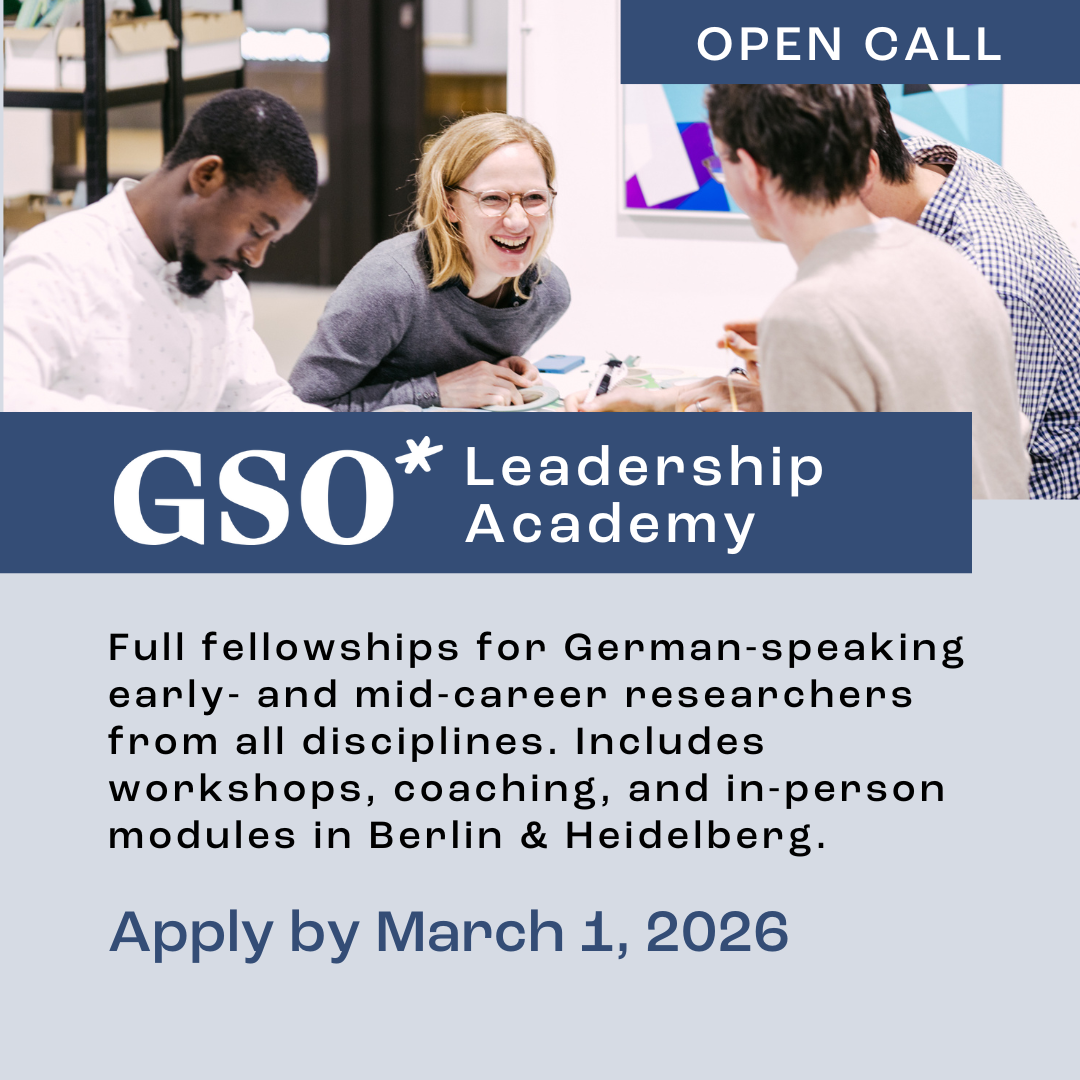
GSO Leadership Academy 2026 – Individual Development and Strong Networks

What?
The GSO Leadership Academy (LSA) supports early- and mid-career researchers in finding answers to key questions of academic and professional leadership.In an interdisciplinary and international setting, the program equips participants with the tools and insights to take responsibility in research, business, non-profit organizations, or as founders.

Who can apply?
German-speaking early- and mid-career researchers from all disciplines at universities and research institutions abroad, as well as researchers who have returned to Germany within the last 18 months.
Applicants must hold at least a postdoctoral qualification (or equivalent) and aim to continue their career in Germany.

Funding
Each year, 25 full fellowships are awarded to outstanding academics who demonstrate leadership potential.
The fellowship covers:

  • Course fees, travel, and accommodation costs (according to GSO guidelines)
  • Meals during training sessions and participation in the accompanying program
  • Career coaching, mentoring, and networking through the AlumNode alumni platform
  • Selected fellows contribute a one-time commitment fee of €150.

Additional program details
The program consists of two in-person training phases in Berlin and Heidelberg (Germany) and includes a comprehensive package of career coaching, mentoring, and network activities.
It provides systematic career planning, personal development, and preparation for leadership roles in research and beyond.

Deadline
March 1, 2026, 23:59 (CET)

Submission
Applications must be submitted online via GSO Leadership Academy – Program Information.

If you have further questions, please contact Tobias Renner via e-mail.

HIDA Mobility Program: Call for Applications

What?
The HIDA Mobility Program enables fully funded short-term research stays (1–3 months) for all Helmholtz employees at another Helmholtz Center or at international partner institutions in Norway and South Korea. Projects must have a clear link to (applied) data and information sciences. The program aims to foster interdisciplinary collaboration, facilitate the exchange of expertise, and support the exploration of new research domains.

Who can apply?
PhD researchers, postdocs, senior scientists, and administrative staff at Helmholtz Centers working in fields with a strong connection to data and information sciences.

Applications are currently accepted for the following funding lines:

  • Helmholtz Internal Mobility Program (Exchange between Helmholtz Centers): Allows Helmholtz researchers and administrative personnel who work with a strong link to the data/information sciences to spend a research/project stay of up to three months at another Helmholtz Center to broaden their expertise and initiate new collaborations. PhDs, Postdocs, Senior Scientists as well as administrative personnel are eligible to apply.For an overview of the 18 Helmholtz Centers and their expertise in Data Science and AI, visit the Coming to Helmholtz page.
    Information on Helmholtz scientists who are open to hosting researchers within the HIDA Mobility Program can be found in the Helmholtz Hosts database.
  • Norway Mobility Program: Enables research stays from 1-3 months at one of the 17 institutes of the Norwegian Artificial Intelligence Research Consortium (NORA), our partner in Norway. PhDs, Postdocs and Senior Researchers as well as administrative personnel at Helmholtz Centers are eligible to apply for the program.
  • South Korea Program (new): Enables research stays from 1-3 months at one of 22 research institutes of the Korean National Research Council for Science and Technology (NST), our partner in Korea. PhDs, Postdocs and Senior Researchers as well as administrative personnel at Helmholtz Centers are eligible to apply for the program.

Funding
The program covers travel and accommodation expenses of up to €2,000 per month.

Additional requirements / selection criteria

  • The proposed project must demonstrate a clear data and information science link.
  • Applicants should aim to strengthen interdisciplinary exchange and initiate or deepen collaborations.
  • Hosts should ideally be listed in the Helmholtz Host Database.

Deadline: Applications are accepted on a rolling basis.

Submission
Applications can be submitted through the HIDA Mobility Program portal. 

Call for Helmholtz Hosts: If you are a Helmholtz scientist working with data science and would like to be listed in the Helmholtz Host database in order to welcome scientists in your group, please write an e-maill to hida.mobility@helmholtz.de.

If you have further questions, please contact Stefanie Gruber-Sliva via e-mail.

ANR-DFG 2026 - French-German Collaboration for Joint Projects in Natural, Life and Engineering Sciences (PRCI)

What?
The French Agence Nationale de la Recherche (ANR) and the Deutsche Forschungsgemeinschaft (DFG; German Research Foundation) have agreed to continue publishing annual calls for French-German projects in the natural, life and engineering sciences (excluding space technology, nuclear research and defence). Responsibility for the administrative processing and the review process for proposals submitted under these calls alternates annually between ANR and the DFG.

Deadline: March, 2026 

If you have further questions, please contact Manuella Werp via e-mail.

Université Franco-Allemande (UFA) – Deutsch-Französische Hochschule (DFH) 

Different funding opportunities for double degrees*, PhD-Track programs*, preparatory meetings, doctoral colleges*, joint PhDs*, scientific events, Franco-German chairs.

Some of the funding mechanisms are open all the year.

Learn more about the calls in German or French.
For further questions, please write an e-mail to Manuella Werp.

DAAD - ERA Fellowships: Green Hydrogen 

The DAAD scholarship program “ERA Fellowships – Green Hydrogen” provides support for German and international PhD students and postdocs working on topics related to Green Hydrogen. It funds studies, research, and internships both in Germany and internationally.

The following funding program's are available:
  • PhD students: Funding for research or training projects on Green Hydrogen at universities, research institutes, or companies (including self-organized internships). 
  • PostDocs: Research fellowships provide funding for a research stay abroad or a part of a research project. 
Who can apply?:
  • PhD students currently enrolled in a German university, university of applied sciences, or non-university research institutions) 
  • PostDocs (currently conducting research in Germany) interested in Green Hydrogen topics can apply. 
Participants will engage in one of four working groups: Production, Transport and Infrastructure, Market Stimulation (development of the hydrogen market), or Cross-Cutting Issues (regulation, socio-economic, and legal frameworks).

Duration of the funding:
  • for PhD students: 1 to 18 months for research fellowships and 2 to 3 months for internships.
  • for PostDocs: 1 to 18 months.
If you are interested you can apply directly through the DAAD scholarship database

Henriette Herz Scouting Program by Alexander von Humboldt Foundation

Have you already made a name for yourself in your field? Or are you at the beginning of a promising executive research career? Are you also well-connected internationally and have already mentored junior researchers?

Then the Henriette Herz Scouting Program could be the right one for you. They specifically want to recruit researchers as scouts who already have their own international network and would like to expand their team to include an excellent Humboldt Research Fellow

Two program lines invite applications from both up-and-coming academics, who are (junior) professors or group leaders, as well as established researchers.

If you do not wish to receive information about future events, you can unsubscribe from the newsletter by sending us
an e-mail.
%