IMPORTANT: If this newsletter is not displayed correctly and you can´t open the links,
please click here.
Please note: The display may vary depending on the browser you are using.
Platzhalter

IScO Newsletter February 2026

Platzhalter

Dear Reader,

February in Karlsruhe brings carnival season, here called Fastnacht or Fasching. You will notice more costumes, parades, and events in the region, and the school holidays run from February 16 to 20. Some people love the lively atmosphere, others use the break for skiing or a wellness weekend.

Later in the month there are a few dates that are especially useful for international residents: stricter checks for the UK ETA are expected from February 25 if you are planning a trip, and the Basler Fasnacht runs from February 23 to 25 for anyone who wants to see a very different carnival tradition nearby. As spring approaches, keep an eye out for amphibian migration on paths near woods and water, and remember that stronger pruning of trees and hedges is only permitted until the end of February.

With so many news for this coming winterseason, there is plenty to explore in this newsletter.You’ll find updates on upcoming IScO events, KIT news and announcements, and external news that could be of interest to you, including exciting funding opportunities. Plus, we’ve gathered the latest calls for proposals that might just spark your next project. Whether you're looking for new collaboration opportunities or staying up-to-date with cultural initiatives, there’s something for everyone!

Stay curious and take care!

Platzhalter

Good Morning, Karlsruhe

Good Morning, Karlsruhe is a new welcome series by the International Scholars and Welcome Office (IScO) for international academics and researchers at KIT. Meet the IScO team, ask questions, and connect with other international scholars in an informal setting with light refreshments. Next event: Monday, February 23, 2026, 9:00 to 11:00 AM.
Platzhalter

IScO´s Excursion: Hotel Silber

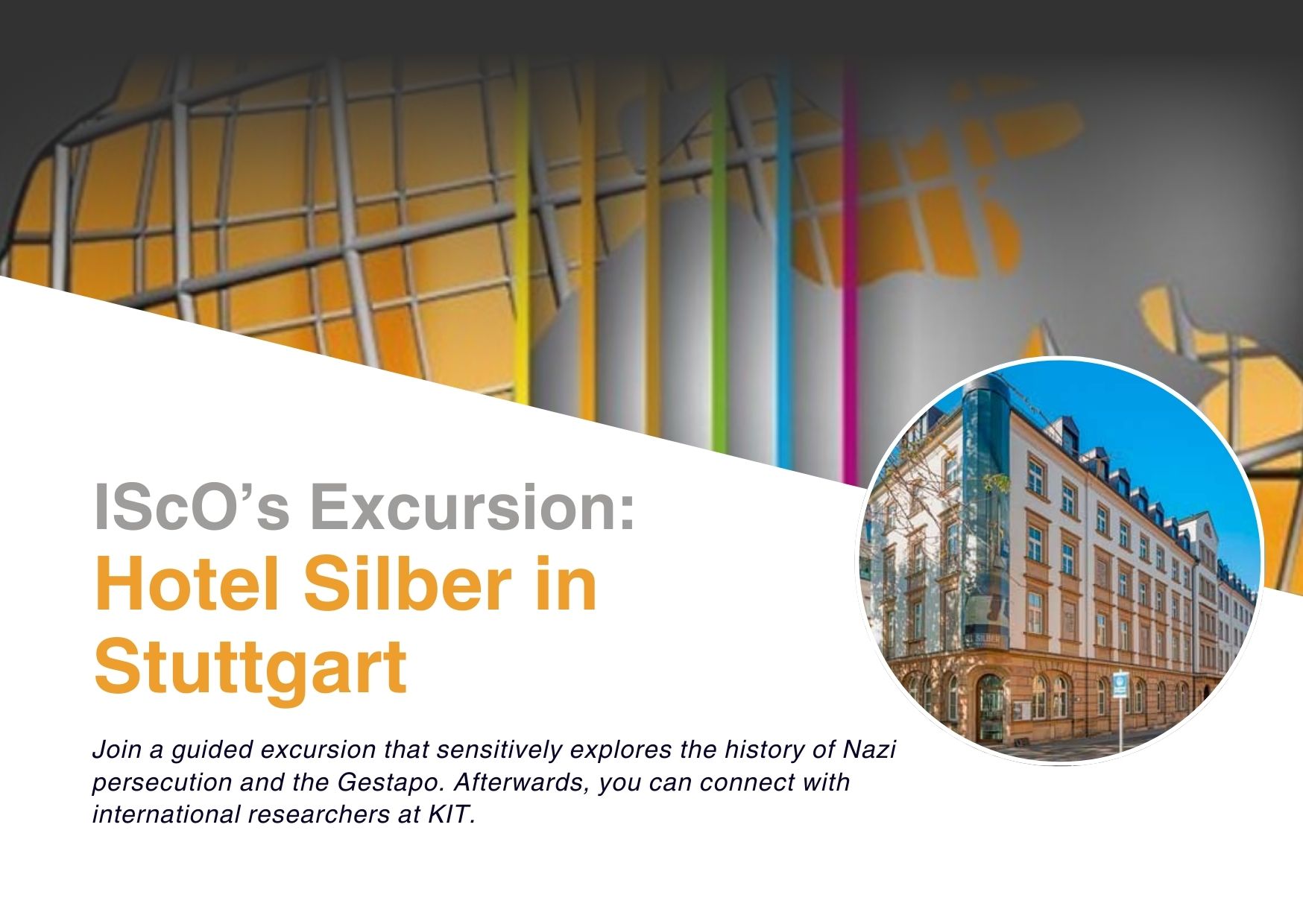
Join IScO for a guided visit to Hotel Silber in Stuttgart, a place of remembrance and exhibition on policing, the Gestapo and persecution. Saturday, February 21, 2026, we will attend the 1.5 hour guided tour “Police and Genocide in Europe” starting at 11:00 AM.

Platzhalter

IScO´s Excursion: Karlsruhe City Tour - History and Highlights of the “Fan City”

Join IScO for a guided walking tour of Karlsruhe and discover fascinating stories and fun anecdotes from three centuries of city history. The tour will take place on Saturday, March 21, 2026 at 11:30 AM. 

Overview

Excursions and News from IScO

News and Announcements from KIT
External News and Announcements 
Current Calls for Proposals

Excursions and News from IScO

Good Morning, Karlsruhe 

What?
Good Morning, Karlsruhe is a new welcome series by the International Scholars and Welcome Office (IScO). It offers international academics and researchers a warm, personal point of contact at KIT and will be hosted every other week. Meet the IScO team in person, ask questions, get orientation on institutional and practical matters, and connect with fellow international scholars in an informal and welcoming setting. Light refreshments will be provided. Please note that photos may be taken for communication and documentation purposes. If you prefer not to be photographed, please inform the organizers in advance.

Goals of the events 

  • Form a foundational pillar of a strong international welcoming culture at KIT
  • Serve as an approachable and reliable reference point between international scholars and their new academic and social environment.
  • Appreciate the diverse cultural backgrounds and experiences of international visitors.

Target group
Newly arrived international researchers and visitors at KIT. International academics who are already at KIT are also welcome to join.

Good Morning, Karlsruhe! Launch Recap

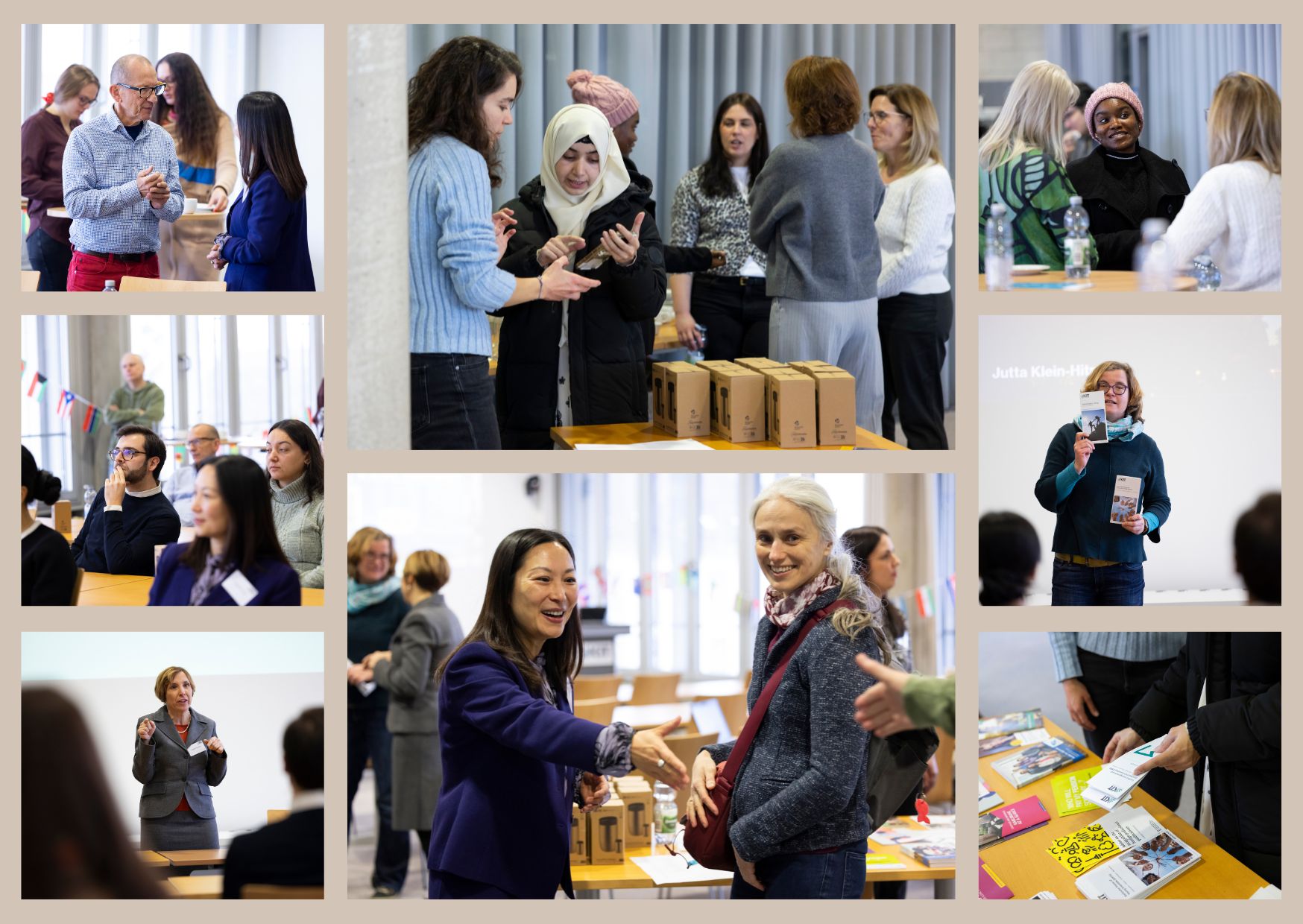
Our first Good Morning welcome event was a truly energizing start to the day. We welcomed international researchers and professors from 12 countries and 10 institutes, all beginning or continuing their academic journeys at KIT. What made the morning special was the atmosphere: open, friendly, and genuinely curious. Thank you to everyone who joined us and filled the room with joy, openness, and enthusiasm. If you missed the launch, we would love to see you at an upcoming session. Come for a relaxed start to the day and leave with new contacts, useful pointers, and a stronger sense of belonging on campus.

When is the next event?
Monday, February 23, 2026, 9:00 to 11:00 AM

Where is the next event?
KIT-Campus South, Building 50.20, Office 005 (Ground Floor), Adenauerring 2, 76131 Karlsruhe


Registration: Please register for the event online

Two more events are scheduled in March

  • Date and Time: Monday, March 9, 2026 and Monday, March 23, 2026 from 9:00 to 11:00 AM.
  • Venue: KIT-Campus South, Building 50.20, Office 005 (Ground Floor), Adenauerring 2, 76131 Karlsruhe.
  • Registration: Registration required. Please use the registration link.

IScO´s Excursion: A glimpse into the history - Hotel Silber as the Headquarter of the Nazi Secret State Police

Join IScO for a guided visit to Hotel Silber in Stuttgart, a place of remembrance with a permanent exhibition on the history of policing, the Gestapo and persecution. The building was already used as a police site during the Weimar Republic. Under National Socialism, it became a key location connected to the Gestapo, from which surveillance, repression and persecution were coordinated, affecting many people in Württemberg and Hohenzollern and beyond. After 1945, the building continued to be used by the police, and its later history also raises complex questions about continuity, accountability and remembrance.

Today, the exhibition traces both breaks and continuities from the Weimar Republic through the Nazi dictatorship and into the post war period. Using documents, photographs and media stations, it examines how democratic institutions could be undermined so rapidly, how authorities and individuals became involved in state violence, and how the role and self understanding of the police shifted across dictatorship and democracy. The exhibition also preserves personal traces from the site, including inscriptions left by prisoners and objects that reflect the repression of everyday life and youth culture at the time.

As part of our visit, we will take part in a 1.5 hour guided tour titled Police and Genocide in Europe. The tour starts at 1 PM and looks at the role of the Württemberg Gestapo and Criminal Police in the persecution and deportation of Jews as well as Sinti and Roma from Württemberg and Hohenzollern, and at how staff connected to Hotel Silber were deployed in other parts of Europe. It also explores individual responsibilities and the consequences for those who were targeted. The tour is designed to support learning and reflection in a respectful setting.

After the tour, we can head to lunch together in Stuttgart if you’d like, and decide on a place once we meet. If you prefer, you can also take the train back to Karlsruhe after the guided tour.

  • Date: Saturday, February 21, 2026
  • Meeting time: 11:00 AM at the main train station in Karlsruhe in front of McDonalds. We will take the RE1 train at 11:30 AM to Stuttgart main station. Then we will walk for 15 minutes to the Hotel Silber.
  • Venue: Hotel Silber, Stuttgart
  • Registration: Registration required until February 16, 2026. Please also register any friends, colleagues or children that you plan to bring along.
  • Cost: €10 per person. A train ticket is not included. The ticket currently costs €17.10. If you have a Deutschlandticket, you can use it (so no extra ticket is needed), as the train we will take is covered by the Deutschlandticket.

If questions arise, please write us an e-mail
Please feel free to share this offer among your network!

IScO´s Excursion: Karlsruhe City Tour - History and Highlights of the “Fan City”

Join an English-language walking tour (1,5 hours) through Karlsruhe and discover fascinating stories and fun anecdotes from three centuries of city history. Learn why Karlsruhe is called the “Fan City,” how its founding is linked to a margrave’s nap, and why there is a pyramid on the market square.

The tour takes you to the city’s key landmarks, including the baroque palace, the market square with its town hall and main church, the palace gardens, and the botanical garden with historic greenhouses. Along the way, you’ll hear about Margrave Karl Wilhelm, court life, and the move of the residence from Durlach to Karlsruhe. You’ll also get insights into Karlsruhe’s role as the home of Germany’s highest courts, including the Federal Constitutional Court and the Federal Court of Justice.

  • Date: Saturday, March 21 , 2026
  • Time: 11:30 AM
  • Venue: We’ll meet in Karlsruhe at the pyramid on Marktplatz, the actual pyramid, not the tram station
  • Cost: €10 per person for the tour
  • Registration: Registration required. Please also register any friends, colleagues, or children you plan to bring along in a separate form (for organizational reasons).

We are looking forward to meeting you!

If questions arise, please write us an e-mail
Please feel free to share this offer among your network!

News and Announcements from KIT

ICM Future Mobility Grants of the InnovationCampus Mobility of the Future (ICM)

The ICM Future Mobility Grants of the InnovationCampus Mobility of the Future (ICM) support institutes at KIT in quickly and pragmatically initiating or expanding international research collaborations. The grants are particularly suitable for preparing joint research projects and larger third-party funding proposals. International guests are closely supported by the ICM and IScO team both during the preparation phase and throughout their stay, ensuring smooth onboarding and effective collaboration with the host institute.

Four funding formats are available:

Mid-term Fellowships for Experts:

For two to six-months stays of international senior scientists at the University of Stuttgart or at KIT (Fellowships).

  • For whom: Postdocs, experienced scientists, professors from abroad
  • Duration: 2-6 months stay at KIT or the University of Stuttgart

Short-term Grants for International Collaboration:

For multiple stays of international senior scientists at KIT or at the University of Stuttgart.

  • For whom: Postdocs, experienced scientists, professors from all countries.
  • Duration: several short research stays within one calendar year at KIT or the University of Stuttgart.

Visiting Professors / International Experts:

For advisory contracts of international senior scientists at KIT or at the University of Stuttgart.

  • For whom: Postdocs, experienced scientists, professors from all countries.
  • Duration: advisory contract with minimum duration of 12 months

Short-term Grants for Talents:

For a several weeks stay abroad of young scientists of KIT or the University of Stuttgart.

  • For whom: Doctoral researchers and postdocs of KIT or the University of Stuttgart
  • Duration: research stay abroad for several weeks

If you already have a potential partner or collaboration idea in mind, we would be happy to advise you briefly on the most suitable funding line. Please contact Catherine Baumann via e-mail or by phone: +49 173 97 97 896.

Information sessions on a broad range of funding schemes and support options, organized by KIT Research Office (FOR)

The KIT Research Office (FOR) is pleased to invite all KIT researchers to a series of free online information events in 2026, providing comprehensive information on a broad range of funding schemes and support options:

The KIT Research Office offers an overview for all events in 2026.

Welcome Event for Doctoral Researchers, organized by Karlsruhe House of Young Scientists (KHYS)

What?
This welcome event introduces services and support for doctoral researchers at Karlsruhe Institute of Technology. A short presentation covers how to make the most of the doctoral phase, including research stays abroad and relevant KIT services. Two more advanced doctoral researchers will share brief testimonials and answer questions. The evening ends with informal networking with snacks and drinks.

For whom?
All German and international doctoral researchers at KIT, especially those who have recently started their doctorate. The welcome event takes place four times a year.

Date and Time
Thursday, March, 5,  2026, from 5:00 to 7:00 PM

Venue
Seminar room Forum, Building 30.95

Format
In person

Registration
Registration is required. Maximum number of participants: 80

If you have further questions, please contact Jutta Klein-Hitpaß via e-mail.

KIT Internal Call: Friedrich und Elisabeth Boysen Dissertation Prize 2026

What?
The nonprofit Friedrich and Elisabeth Boysen Foundation honors an outstanding dissertation by a young researcher at Karlsruhe Institute of Technology (KIT) in the field of environmental technology, with a particular focus on engineering solutions that optimize energy consumption and reduce pollutants and noise. The foundation supports science and research, with a particular focus on environmental protection.

Where?
KIT internal selection process coordinated by Karlsruhe House of Young Scientists (KHYS). Digital submission by email.

When?
Eligibility window: doctorates completed at a KIT department between January, 1, 2025 and  December, 31, 2025. The decisive factor is the date of the defense. The award ceremony is organized by the KIT department of the respective winner.

Target group
Early career researchers who completed their doctorate at a KIT department in 2025, with a dissertation in environmental technology (engineering focused, especially energy optimization and reduction of pollutants and noise).

Prize
One-time cash prize of EUR 5,000. Please note that prize money may be subject to income tax and social security contributions.

Additional requirements / selection criteria

  • Eligible candidates must have completed their doctorate at a KIT department between 1 January 2025 and 31 December 2025, based on the date of the defense
  • Nominations must be submitted by KIT professors
  • Self-nominations are not permitted

Submission and Deadline
Submit the nomination via e-mail by March, 30, 2026. Documents must be submitted digitally as specified on the KIT Internal Call: Friedrich und Elisabeth Boysen Dissertation Prize 2026 Website.

If you have further questions, please contact Nadja Mazko via e-mail.

Individual Career Coaching with External Coaches (KHYS)

What?
Career coaching offers postdocs and doctoral researchers in the final stages of their doctorate the opportunity to work on individual career related concerns with a professionally trained external coach of their choice. The aim is to support you in clarifying, planning, and implementing your current and future academic or non-academic career and in developing your own solutions.

Who can apply?
Postdocs and, if places remain, doctoral researchers in the final stages of their doctorate. You must be a member of KHYS when registering and when conducting the coaching sessions.

What can coaching focus on?
Coaching occasions can relate to topics such as:

  • Clarifying and strengthening professional identity (for example professional goals, decision making, career strategy, visibility, career change, role clarity, self-presentation, appointment coaching)
  • Strengthening leadership skills (for example leadership role, leadership style, self-concept as a leader)
  • Compatibility of family and career, work life balance, and managing conflict and stress

Scope of funding
KHYS covers the costs of one-to-one coaching with an external coach of your choice up to a maximum total amount of EUR 500 plus any applicable VAT per funded person. Only coaching fees are covered, not travel expenses or similar costs. Coaching can be carried out up to and including September 2026 after you receive the funding approval.

Registration, procedure and deadline
To register, complete and sign the registration form and send it to coaching@khys.kit.edu by March, 2, 2026. Places are limited and registrations are processed in the order received, first come first served, with priority for postdocs. You will receive feedback by email in mid-March 2026. If approved, you will independently look for and commission a coach. KHYS provides an overview of possible coaching providers together with the funding approval, but you do not have to choose from that list.

If you have further questions, please contact Andreas Hahmann.

KHYS FIT Course Offerings: Fit for your next career step

What?
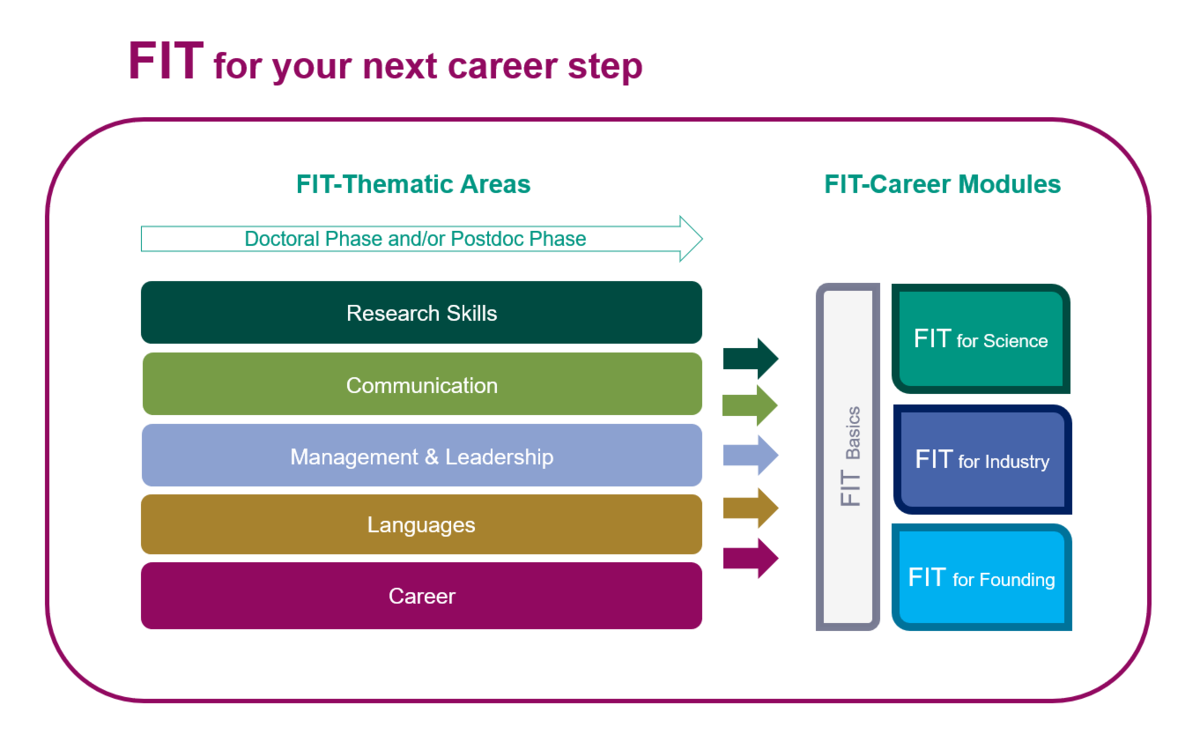
The KHYS Further Education Program “Fit for your next career step” is a structured portfolio of training courses that supports your professional development during the doctoral and postdoc phase. It brings together expertise from established external trainers and institutions at Karlsruhe Institute of Technology.

Who is it for?
The overall FIT course program is aimed equally at doctoral researchers and postdocs. Courses with a particular focus for doctoral researchers or postdocs are marked accordingly (D or P). You can also use the dedicated KHYS overview pages for Doctoral Researchers and for Postdocs to identify courses that fit your current qualification phase.

How to choose the right courses
The FIT overview helps you filter in two ways:

  1. By topic area, for example Research Skills, Communication, Management and Leadership, Languages, Career, E Learning, and Teaching.

  2. By career path, using the module labels FIT for Science, FIT for Industry, FIT for Founding, and FIT Basics.

Examples of topics covered
Within Research Skills, listed course topics include Doctoral and Postdoc Phase: Milestones and Processes, Managing Information and Data, Third Party Funding, and Methods and Good Research Practice. Research skills are described as relevant for careers in science, and also useful for industry paths and founding.

Where to find the individual course dates
Use the Event Calendar. Icons with coloured borders indicate which subject area a course belongs to, and you can match them to the subject areas shown in the overview.

If you have further question, please contact Viola Schroff for organisational questions and Dr. Claire Earnshaw and Dr. Lisa Leander for content-related matters.

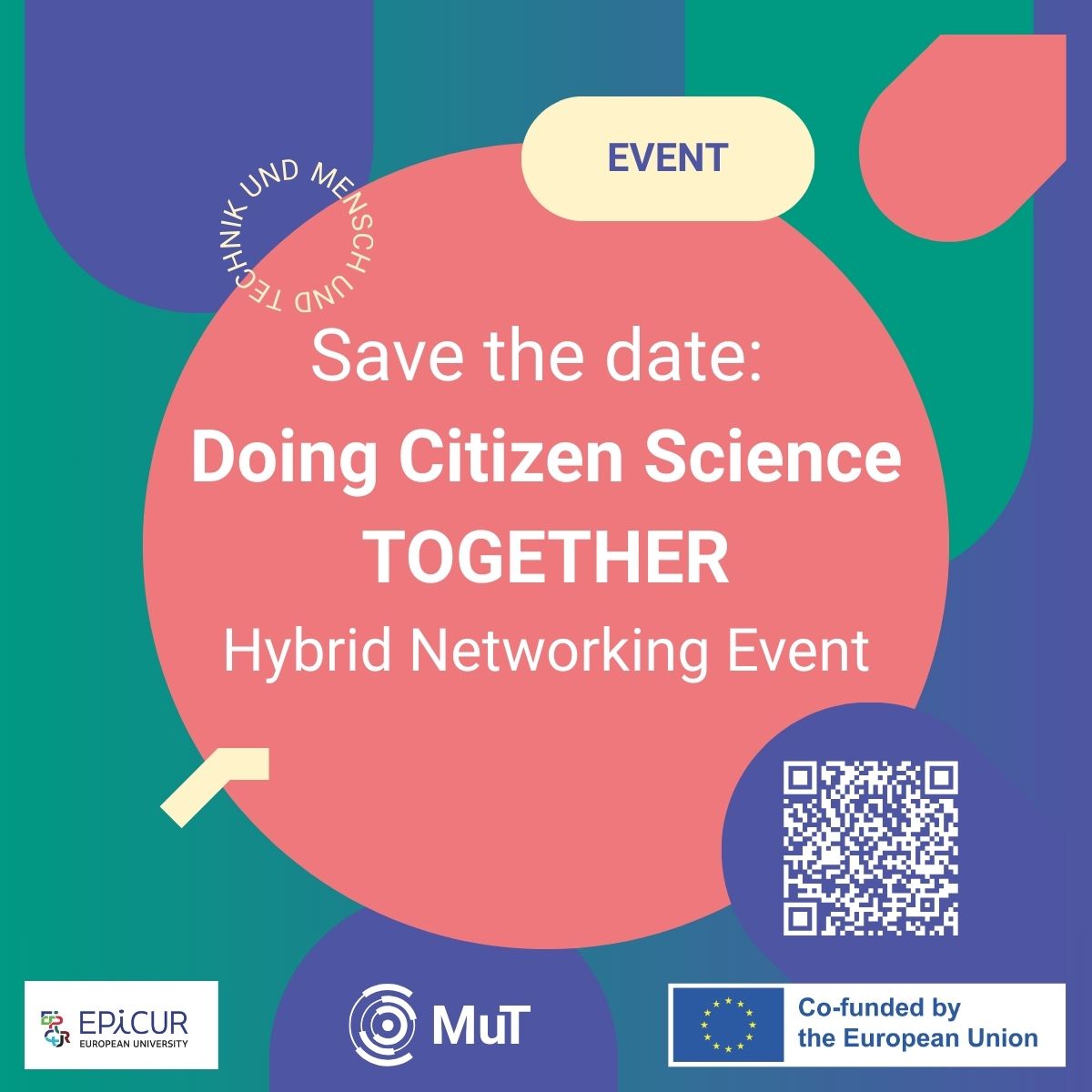
Doing Citizen Science TOGETHER – Network Meeting

Everything is easier when you know the right people – and Citizen Science is no exception. Let’s share our theoretical and practical knowledge on DOING CITIZEN SCIENCE. Get insights on current Citizen Science developments from KIT & EPICUR experts in two keynotes and then mingle & connect amongst other Citizen Science Researchers on site or online in guided formats. 

For whom?
Current or future researchers & practitioners from the field of citizen science at KIT, in Karlsruhe and from the EPICUR network.

When?
March, 3, 2026, 9:00 AM -2:00 PM

Where?
TRIANGEL Transfer | Kultur | Raum, Kaiserstraße 93, Karlsruhe or online via Zoom

Please register on the Doing Citizen Science Website

If you have questions, please contact Hoai Truong and Meike Hebich via e-mail.

Helmholtz-OCPC Program: Call for Applications

What?
The Helmholtz OCPC Program supports the involvement of postdocs in bilateral collaboration projects between Helmholtz centres (here: Karlsruhe Institute of Technology) and partner institutions in China. It is funded jointly with the Office of the China Postdoctoral Council and aims to strengthen sustainable research cooperation by enabling postdocs to conduct research at KIT for up to two years.

Who can apply?
This call works through a project proposal from KIT and an application route via China.

Target group on the candidate side:

  • Primarily talented Chinese candidates from a postdoc research station registered with OCPC
  • Young scientists under the age of 35 with a Chinese passport
  • Applicants who obtained their PhD, or will obtain it before the final decision in September 2026, in China or abroad
  • Applicants of other pathways may be eligible if they can find a postdoc research station to accept their application and recommend them to OCPC
    Important procedural note: candidates who apply directly to OCPC, without going through a postdoc station, will not be considered by OCPC.

The funding is composed of two parts:

  • OCPC funded research grant of RMB 300,000 for two years (equivalent to approx. EUR 1,511.56 per month, based on the exchange rate cited in the call), intended for subsistence allowance, health insurance, and travel expenses during the stay at KIT
  • A KIT fellowship of EUR 1,500 per month from decentralised KIT budgets (for example an institute budget), funding must be secured; the fellowship includes insurance contributions and travel expenses while staying at KIT

Deadline

  • KIT institutes submit project proposals to KIT International Affairs by February, 21, 2026
  • The public call on the OCPC side is expected to be announced before March, 2, 2026, with a defined candidate application deadline of April, 30, 2026 (applications must be submitted via a postdoc station)
  • Helmholtz and KIT timeline: candidate materials forwarded by May, 15, 2026, KIT decisions communicated by mid July 2026, final OCPC decision expected by end of August 2026, approval letters expected by October 2026
  • Successful candidates are expected to start work at KIT within six months of receiving confirmation from OCPC

Submission

  1. KIT project proposal (English, structured according to the provided form):
    Submit to KIT International Affairs by February, 21, 2026.
  2. Candidate application to OCPC (via a Chinese postdoc research station):
    Candidates submit documents to OCPC through their postdoc station by the published deadline (expected 30 April 2026). Applications submitted directly to OCPC without a postdoc station will not be considered.

If you have further questions, please contact Oliver Kaas via e-mail.

Schmidt Science Fellows 2027: Call for Nominations

What?
The Schmidt Science Fellows (SSF) Program supports outstanding doctoral researchers in the natural sciences, engineering, mathematics, and computing who want to broaden their horizons by pivoting away from their PhD research area and conducting postdoctoral research in a different discipline. The program combines research funding with leadership and innovation training at a self-chosen leading academic institution worldwide. It is administered by Schmidt Futures in partnership with Rhodes Trust.

Who can apply?
This call runs via an internal nomination process at Karlsruhe Institute of Technology (KIT). Scientists at KIT who supervise doctoral candidates can propose qualified candidates. KIT can submit up to seven nominations. Individual applications are not possible.

In order to be eligible for nomination and potential selection as a Schmidt Science Fellow, candidates must meet the following requirements:

  • Graduate degree in the natural sciences, Engineering, Mathematics or Computing with a commitment to interdisciplinary science
  • Have completed or expect to complete all of the requirements for the conferral of their doctorate in one of these fields between May 1, 2026 and June 30, 2027
  • Be able to start their fellowship in July 2027 or October 2027 and available from April 2027 to July 2028 to attend onboarding activities, the in-person Science Leadership Program convenings, and the annual Schmidt Science Fellows Interdisciplinary Science Summit

Funding

  • Stipend of USD 110,000 per year for research, for up to two years (up to USD 220,000 total)
  • Participation in leadership and innovation trainings at a self-chosen leading academic institution worldwide

Selection process overview:

  • KIT selected nominees receive an authorization code to register for the SSF online application process (registration window May, 19 to June, 1, 2026)
  • Full applications due by July, 13, 2026
  • Academic reviews August to October 2026, online interviews in January 2027
  • Awardees announced in April 2027
  • Global placement selections July to October 2027

Online briefings for prospective candidates (hosted by Dr. David McAllister, Director of Selection and Outreach):

  • Session 1: Monday, February, 23, 2026, 6 PM CEST. Please register online.
  • Session 2: Tuesday, February, 24, 2026, 10 AM CEST. Please register online.
  • Who can attend:
    • PhD candidates interested in applying
    • Institutional staff involved in nominations

Registration required, recordings available, and a sample application form is provided for reference.

Deadline
For the KIT internal nomination: submit the complete nomination package by April, 24, 2026. For nominees continuing in the SSF process: registration is open from May, 19 to June, 1, 2026, and the SSF application deadline is July, 13, 2026.

Submission
Scientists of KIT who supervise doctoral candidates are requested to propose qualified candidates to the International Affairs Business Unit by April 24, 2026 to via e-mail. KIT-internal selection recommendation is made via CRYS. Required nomination documents can be found online.

If you have further questions, please contact Oliver Kaas.

Aspirant Grant (Doctoral Researcher/Postdoc) by Karlsruhe House of Young Scientists (KHYS) 

Asprirant Grant (Doc/Postdoc) enables KIT professors and research group leaders to invite promising scientists who are interested in doing research at KIT as a doctorate researcher/postdoc in the near future to spend one month on-site. During the visit, both parties receive the chance to get to know each other and to discuss the possibility of doing a doctorate/postdoc at KIT. The funding measure is part of the KHYS Postdoc Office and is sponsored by the Initiative and Networking Fund of the Helmholtz Association.

Target group: KIT professors and research group leaders

Funding: KHYS will cover the travel and accommodation expenses for the aspirant’s stay

Deadline: Applications for both measures may be handed in anytime as long as funds are available.

If you have further questions, please contact Denisa Kičmerová (KHYS) via e-mail.

Please feel free to share this offer among your network!

External News and Announcements

Events in Karlsruhe

Do you want to get in touch with other English Speaking people?:

  • The American Library has regular events in English for kids and adults.
    For adults: Poetry?Please! (February, 24, 2026).
    For kids and teens: Storytime in English for Kids 3 to 5 (February, 25, 2026), Reading Time (Ages 6 & up) (February, 27, 2026), TeenTime (February, 27, 2026).
  • The Karlsruhe Toastmasters (Website only available in German) meet every 1st, 3rd and 5th Monday of the month from 7:15 to 9:15 PM to practice public speaking in English with friendly, relaxed support from speakers from around 
    the world. 

Do you want to improve your German?:

  • Sprecht miteinander! Speak with each other!
    Practice your spoken German in a relaxed atmosphere. People of similar language ability form groups moderated by a volunteer. Free and no registration required. Wednesdys and Fridays from 6:30 to 8:00 PM.
    Bürgerzentrum Mühlburg (BZM)  Weinbrennerstr. 79a  76185 Karlsruhe
    Just stop by
  • The IBZ offers practice in speaking German via Skype on Mondays and in person on Thursdays from 6:30 to 8:00 PM.
  • Other opportunities to practice speaking in German can be found on the Integration page of the City of Karlsruhe. Just switch the language (Sprache) at the top of the page to find out more.

What events are coming up in Karlsruhe?:

  • February 16 — Rosenmontagsumzug (carnival parade; Website only available in German) in Ettlingen starting at 14:01. Expect about 85 groups marching through the center of Ettlingen. Afterwards, join others inside at the Schlossgartenhalle to continue the celebration.
  • February 16 – Rocky Horror Picture Show (50th Anniversary) in the original at the Schauburg (Website only available in German) movie theater at 9 pm. Rice, toilet paper, newspaper and confetti are allowed. NO sparklers or flour. This one sells out fast.
  • February 17 — Parade in Karlsruhe starting at 14:11 until about 16:30 with 80+ floats and marching bands. The parade ends at Rondellplatz, but the music and activities continue at Marktplatz from 16:31 to 18:31.
  • February 17 — Downtown Karlsruhe is closed in the afternoon because of the aforementioned parade. Many stores close early or don't open at all - especially in the center of town. Come early to get a good spot to watch the parade.
  • February 17 – No trash pick-up on this day because streets are closed for the parade.
  • February 20 – March 8 — The 46th International Händel Festival (Website only available in German) at the Badische Staatstheater. Baroque music at its best. Concerts and operas.
  • February 23 - 25 — Basler Fasnacht starts at 4:00 AM on February, 23, 2026 and runs for 72 hours. The entire inner city of Basel (Switzerland) is dark; the only light comes from those marching in the parade. The Basel Carnival is on the UNESCO List of the Intangible Heritage of Humanity since 2017.

Congress Travel Program by DAAD 

With funding from the Federal Foreign Office, the program promotes active participation in international scientific congresses and conferences abroad (in person and online). Active participation is encouraged. Active participation is defined as the presentation of one's own scientific contribution (poster, lecture or panel).

Target group: Postdoctoral researchers and doctoral candidates. 

Scholarship benefits:
Depending on the travel distance, you can choose from four categories of funding with different funding benefits: 

  • Online participation
  • Presence short distance (up to 600 km as the crow flies, excluding the United Kingdom)
  • Presence medium distance (601 - 3,700 km as the crow flies, plus the United Kingdom)
  • Long-haul presence (from 3,700 km as the crow flies)
These funding categories are designed to make it easier for you to participate in a climate-friendly congress.

DFG Information for the Scientific Communitiy

The Deutsche Forschungsgemeinschaft (DFG, German Research Foundation) continues to support researchers who have fled their home countries. The aim is to enable their short-term integration into the German research system so that they can continue their academic work.

Target group: Doctoral candidates and postdoctoral researchers who fled their home country in the last three years can apply for a Walter Benjamin Fellowship.

Funding:
  • Gain experience at a German academic institution by supervising a research project to establish a foundation for advancing in the German academic system.
  • Receive individual career support from the host institution.
  • Integrate into ongoing projects in various DFG funding programs.
Special Program Ukraine:

The DFG is extending the Special Program Ukraine until further notice. Through this funding opportunity, Ukrainian researchers (project leaders) who are in Ukraine and whose research is still possible can receive special support. You can find more information on the Special Program Ukraine here.

Current Calls for Proposals

Virtual Career Coaching (DAAD and Humboldt Community)

What?
Have you just finished your studies or are you about to graduate, and now you are facing applications, interviews, or bigger career decisions? The DAAD and Humboldt Community offers virtual career coaching exclusively for its members. You can get individual advice from experienced career coaches and choose up to two modules of 60 minutes each.

Coaching modules include:

  • Analysis and improvement of application documents, plus guidance on developing your application strategy
  • Preparation for job interviews and selection processes
  • Next career step or career change, including moving into self-employment and developing your career strategy
  • Other topics depending on your needs, such as work life balance, presentations, and mastering new challenges

Where and when?
Career coaching takes place online in virtual rooms. Registrations can be submitted on an ongoing basis.

Who can take part?
Current scholarship holders and alumni of the Alexander von Humboldt Foundation and the DAAD.

Additional requirements / selection criteria

  • Membership in the DAAD and Humboldt Community with a well maintained profile (registration required)
  • Proof of funding from the Alexander von Humboldt Foundation or the DAAD may be required
  • Technical requirements: fast and stable internet access, webcam, and headse
  • Members can choose up to two coaching modules (60 minutes each)

Registration
Register for the DAAD and Humboldt Community and submit your registration online on an ongoing basis.

If you have further questions, please contact the DAAD & Humboldt Community via e-mail.

Canada-Germany Joint Research-and-Development Projects for Small and Medium-Sized Enterprises: Call for Proposals

What?
Canada and Germany invite joint research-and-development projects to develop innovative products, processes, or technical services across all technology and application areas. Projects are expected to deliver market-ready solutions with strong market potential. Public funding is available through the German Central Innovation Program for Small and Medium-Sized Enterprises and through the Industrial Research Assistance Program of the National Research Council of Canada. The minimum requirement for a consortium is at least one small and medium-sized enterprise from Germany and at least one small and medium-sized enterprise from Canada. Additional companies are welcome, and in Germany research institutions may also participate.

Who can apply?
A project consortium with at least:

  • One company from Germany and one company from Canada, with no corporate ownership link between them
  • Additional partners are possible in line with national funding rules (including research institutions in Germany).

Funding
Eligible project partners in Germany and Canada cover project costs through their national funding programs and provide the required own contribution. Expected project results should lead to market-relevant technological innovations (new products, processes, and or technical services) aligned with the international state of the art.

German funding and eligibility

  • Eligible applicants include German small and medium-sized enterprises under European Union rules.
  • Mid-sized companies with fewer than 500 full-time equivalent employees are eligible if they carry out research-and-development to develop innovative products, processes, or technical services.
  • Mid-sized companies with fewer than 1,000 full-time equivalent employees may also be eligible if they cooperate with at least one eligible small and medium-sized enterprise and that partner’s project is funded.
  • Research institutions may participate as cooperation partners of eligible companies.
  • The German application must follow the German funding guideline and must be written in German.
  • An optional project sketch can be submitted for a non-binding preliminary assessment of funding eligibility.

Canadian funding and eligibility

  • Canadian applicants must be registered as clients of the Industrial Research Assistance Program of the National Research Council of Canada to be considered for funding.
  • Canadian small and medium-sized enterprises may receive up to 50% of eligible project costs.
  • Maximum funding per project is 500,000 Canadian dollars over 12 to 24 months.
  • A 12-month extension may be considered if well justified and accepted by both countries.
  • Eligible applicants are incorporated, profit-oriented small and medium-sized enterprises registered in Canada with up to 500 full-time equivalent employees.
  • Applicants should be committed to growth through global market expansion.

Additional requirements / selection criteria can be found on the Website of the Canadian Government.

Timeline, key dates and deadline

  • Mandatory registration for Canadian project participants with the National Research Council of Canada: March, 17, 2026
  • Mandatory expression of interest from Canadian project participants: March, 31, 2026
  • Optional project sketch from German project partners for an initial eligibility assessment: no later than April, 17, 2026
  • Deadline for national application forms and the joint international Proposal Application Form: June, 19, 2026
  • National funding decisions are expected approximately three months after submission of the joint application forms.

Submission

  • German partners submit their national German application in parallel to the joint Proposal Application Form
  • Canadian partners are invited to submit their national application at a later stage
    Canadian applicants must submit a fully completed expression-of-interest form to the Canadian program by March, 31, 2026. The form is provided by the Canadian program and must be requested from the responsible advisor. German applicants may submit an optional project sketch by April, 17, 2026 for a non-binding preliminary assessment.

For further information, please take a look at the ZIM Website and the German call for proposals (Websites only available in German).

If you have further questions, please contact Andrew Bauder (Canada), NRC IRAP Germany National Program Lead, and Georg Nagel (Germany), Director International Cooperation AiF Projekt GmbH via e-mail.

Fulbright Cottrell Award

What?
The Fulbright Cottrell Award supports junior faculty in chemistry, physics, and astronomy at German universities and research institutes. Successful applicants receive €63,000 for a three-year project that integrates pioneering research with creative teaching. The award also provides €5,000 to support participation in the annual Cottrell Scholar Conference in Tucson, Arizona, and offers access to a transatlantic network of teacher scholars.

Who can apply?
Junior faculty in chemistry, physics, and astronomy at German universities and research institutes.

Funding

  • Funding begins in July 2026
  • €63,000 for a three-year project integrating research and teaching
  • Additional €5,000 for participation in the annual Cottrell Scholar Conference in Tucson, Arizona
  • Participation in a transatlantic network of teacher scholars

Submission
Please see the program website for detailed information and application guidance. 

Deadline
March, 31, 2026

Contact
If you have any questions, please contact the Fulbright Team via e-mail.

JSPS Postdoctoral Fellowship short-term

What?
This program, run in cooperation with the DAAD and the Japan Society for the Promotion of Science (JSPS), enables highly qualified early career researchers from Germany to conduct a short-term research stay at universities and selected research institutions in Japan.

Who can apply?
Postdoctoral researchers and doctoral candidates from all disciplines.

Funding
Research projects at universities and selected research institutions in Japan are supported. Language courses and area studies are not funded.
The fellowship includes:

  • Round trip flight ticket
  • Monthly stipend, approx. JPY 200,000 for doctoral candidates and approx. JPY 362,000 for postdocs
  • Travel health insurance
  • One off start allowance of approx. JPY 200,000 for stays of three months or longer
  • Funding can only be granted in full month modules

Duration

  • Doctoral candidates: 1 to 12 months
  • Postdocs: 1 to 6 months

The fellowship is not extendable. If the doctoral certificate is submitted after the fellowship starts, the stipend rate is increased to the postdoc rate from the month after submission.

Deadline
The application deadline is April, 30, 2026, and the fellowship must start between January 1, 2027 and March 31, 2027.

Submission:

Please send your application documents by post to DAAD:

DAAD
Martina Sternemann
Referat ST34 Asien Pazifik
Kennedyallee 91 101
53175 Bonn

For more information, please visit the DAAD Website (Website only available in German).

If you have further questions, please contact Martina Sternemann via e-mail.

JSPS Postdoctoral Fellowship

What?
The Japan Society for the Promotion of Science Research Fellowship supports highly qualified postdocs from Germany in conducting research in Japan, regardless of discipline. The standard line funds research stays of 12 to 24 months and applications are pre-selected by the Alexander von Humboldt Foundation on behalf of JSPS. You must begin your fellowship in Japan between April, 1, 2026 and November, 30, 2026 of the respective financial year. You may not depart for Japan between December, 1, 2027 and March, 31, 2027.

Who can apply?
Highly qualified postdocs from Germany who meet the requirements stated in the call, including:

  • PhD completed no more than six years ago (cut off date: April 1 of the corresponding financial year) and doctoral certificate available by the latest at the start of the fellowship
  • Peer reviewed publications to international standards
  • German citizenship or a permanent residence permit for Germany
  • Excellent English skills (Japanese is not necessarily required, but may be needed in some fields to carry out the research)
  • Japanese citizens are not eligible (also applies to dual citizens with Japanese nationality), and applicants with a permanent residence permit for Japan are also ineligible
  • You also need an academic host in Japan at a university or selected national research institution, and the host cannot be a close personal or family relation.

Funding

  • Monthly fellowship amount currently JPY 362,000
  • One off settling in allowance of JPY 200,000 for stays of three months or more
  • Travel and insurance allowances may also be paid
    During the stay, the Humboldt Foundation provides a contact person and offers additional support measures, including reintegration support in Germany and alumni sponsorship.

Deadline
The Selection Committee reviews applications in February, June, and October. Please submit your completed application, including all required documents, well in advance of your preferred selection date. Applications are usually processed within four to seven months. Incomplete or inaccurate applications may take longer and are often deferred to a later Selection Committee meeting. After the selection meeting, the Alexander von Humboldt team will inform you of the outcome as quickly as possible by email.

Submission
Apply online to the Alexander von Humboldt Foundation, in English only. Before applying, discuss your independently developed research outline with your chosen academic host in Japan. The documents required for the submission can be found on the Alexander von Humboldt Website.


If you have further questions, please contact the Alexander von Humboldt team via e-mail before submitting your application.

JSPS Invitational Fellowship short-term

What?
The Japan Society for the Promotion of Science Invitational Fellowship (short term) enables excellent overseas researchers to visit Japan for a short period to engage in collaborative research, discussions, opinion exchange, lectures, and related academic activities with researchers in Japan. Applications are submitted by a host researcher in Japan via their university or institution.

Who can apply?
All fields in the humanities, social sciences, and natural sciences are eligible to apply. Eligibility is described for both sides:

Host researcher in Japan (applicant):

  • Affiliated with an eligible research institution under the relevant Ministry of Education, Culture, Sports, Science and Technology KAKENHI procedure and eligible to apply for a KAKENHI grant, and wishes to host an overseas researcher
  • Full time researcher (or, if not employed full time, considered by the host institution able to fulfil the hosting responsibilities throughout the fellowship period)

Invited overseas researcher (candidate):

  • Citizen or permanent resident of a country with diplomatic relations with Japan (Taiwan and Palestine are treated in this manner)
  • Full time researcher, or holds full time researcher status, at a university or research institution outside Japan and has a position equivalent to professor, associate professor or assistant professor in Japan (including positions such as professor emeritus)
  • Researchers of other status may apply if six years or more have passed since their doctoral degree and the host institution judges they have continuously conducted research at a foreign university or research institution
  • Japanese nationals may be eligible if they have lived abroad for ten years or longer and are judged by the host institution to have played an active role in that country’s scientific community

Funding

  • Duration: 14 to 60 days
  • Round trip economy class airfare (based on JSPS regulations)
  • Maintenance allowance of JPY 18,000 per day
  • Overseas travel insurance
  • Research support allowance of up to JPY 150,000 (applied for by the host researcher through their institution)
  • Note: If the invited researcher has been living in Japan and has a mailing address in Japan before the fellowship start date, outbound airfare and a settling in allowance are not paid.

Deadline
April, 28, 2026

Submission
Applications are submitted by the host researcher in Japan through their university or institution, following the JSPS guidelines linked in the call information.

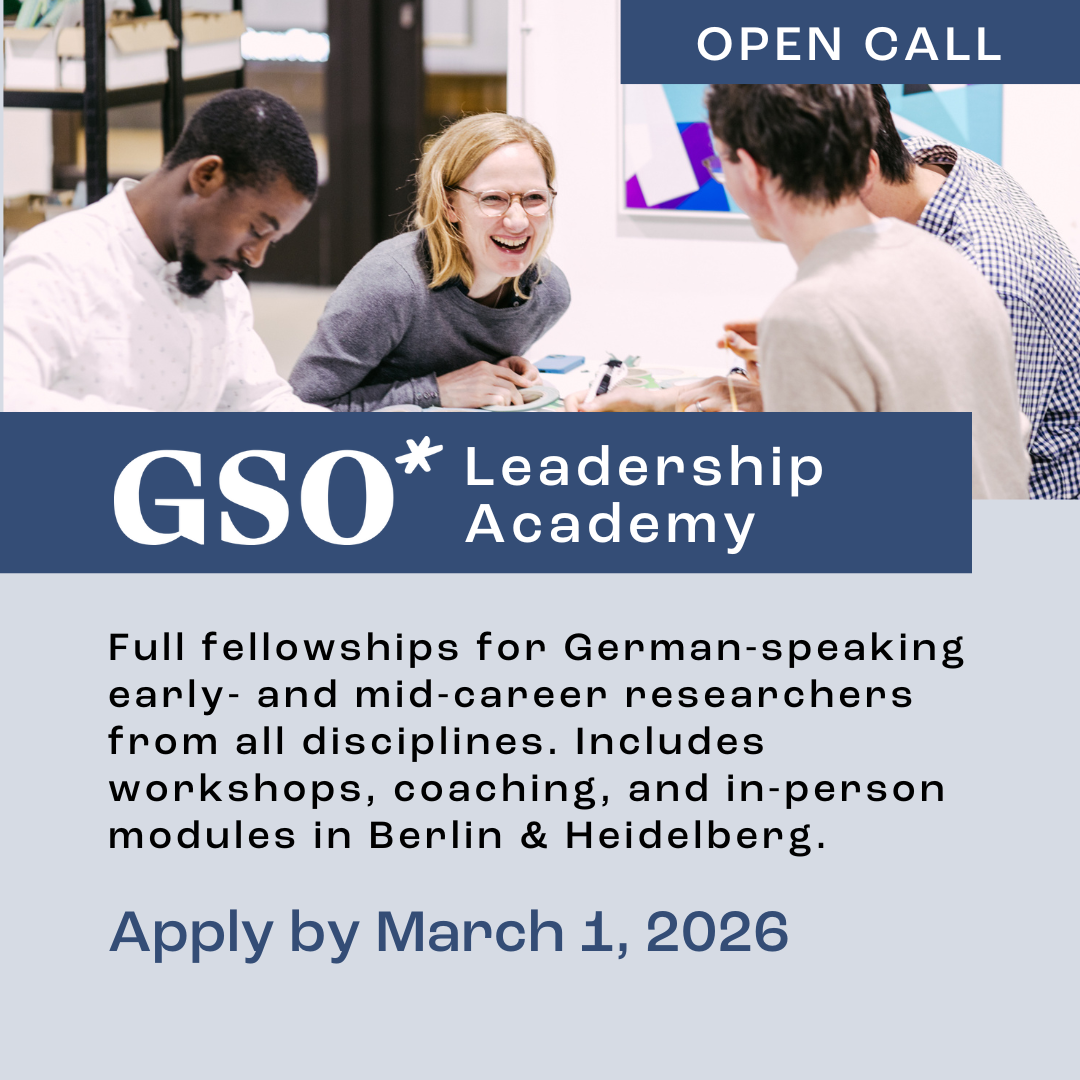
GSO Leadership Academy 2026 – Individual Development and Strong Networks

What?
The GSO Leadership Academy (LSA) supports early- and mid-career researchers in finding answers to key questions of academic and professional leadership.In an interdisciplinary and international setting, the program equips participants with the tools and insights to take responsibility in research, business, non-profit organizations, or as founders.

Who can apply?
German-speaking early- and mid-career researchers from all disciplines at universities and research institutions abroad, as well as researchers who have returned to Germany within the last 18 months.
Applicants must hold at least a postdoctoral qualification (or equivalent) and aim to continue their career in Germany.

Funding
Each year, 25 full fellowships are awarded to outstanding academics who demonstrate leadership potential.
The fellowship covers:

  • Course fees, travel, and accommodation costs (according to GSO guidelines)
  • Meals during training sessions and participation in the accompanying program
  • Career coaching, mentoring, and networking through the AlumNode alumni platform
  • Selected fellows contribute a one-time commitment fee of €150.

Additional program details
The program consists of two in-person training phases in Berlin and Heidelberg (Germany) and includes a comprehensive package of career coaching, mentoring, and network activities.
It provides systematic career planning, personal development, and preparation for leadership roles in research and beyond.

Deadline
March 1, 2026, 23:59 (CET)

Submission
Applications must be submitted online via GSO Leadership Academy – Program Information.

If you have further questions, please contact Tobias Renner via e-mail.

HIDA Mobility Program: Call for Applications

What?
The HIDA Mobility Program enables fully funded short-term research stays (1–3 months) for all Helmholtz employees at another Helmholtz Center or at international partner institutions in Norway and South Korea. Projects must have a clear link to (applied) data and information sciences. The program aims to foster interdisciplinary collaboration, facilitate the exchange of expertise, and support the exploration of new research domains.

Who can apply?
PhD researchers, postdocs, senior scientists, and administrative staff at Helmholtz Centers working in fields with a strong connection to data and information sciences.

Applications are currently accepted for the following funding lines:

  • Helmholtz Internal Mobility Program (Exchange between Helmholtz Centers): Allows Helmholtz researchers and administrative personnel who work with a strong link to the data/information sciences to spend a research/project stay of up to three months at another Helmholtz Center to broaden their expertise and initiate new collaborations. PhDs, Postdocs, Senior Scientists as well as administrative personnel are eligible to apply.For an overview of the 18 Helmholtz Centers and their expertise in Data Science and AI, visit the Coming to Helmholtz page.
    Information on Helmholtz scientists who are open to hosting researchers within the HIDA Mobility Program can be found in the Helmholtz Hosts database.
  • Norway Mobility Program: Enables research stays from 1-3 months at one of the 17 institutes of the Norwegian Artificial Intelligence Research Consortium (NORA), our partner in Norway. PhDs, Postdocs and Senior Researchers as well as administrative personnel at Helmholtz Centers are eligible to apply for the program.
  • South Korea Program (new): Enables research stays from 1-3 months at one of 22 research institutes of the Korean National Research Council for Science and Technology (NST), our partner in Korea. PhDs, Postdocs and Senior Researchers as well as administrative personnel at Helmholtz Centers are eligible to apply for the program.

Funding
The program covers travel and accommodation expenses of up to €2,000 per month.

Additional requirements / selection criteria

  • The proposed project must demonstrate a clear data and information science link.
  • Applicants should aim to strengthen interdisciplinary exchange and initiate or deepen collaborations.
  • Hosts should ideally be listed in the Helmholtz Host Database.

Deadline: Applications are accepted on a rolling basis.

Submission
Applications can be submitted through the HIDA Mobility Program portal

Call for Helmholtz Hosts: If you are a Helmholtz scientist working with data science and would like to be listed in the Helmholtz Host database in order to welcome scientists in your group, please write an e-maill to hida.mobility@helmholtz.de.

If you have further questions, please contact Stefanie Gruber-Sliva via e-mail.

Université Franco-Allemande (UFA) – Deutsch-Französische Hochschule (DFH) 

Different funding opportunities for double degrees*, PhD-Track programs*, preparatory meetings, doctoral colleges*, joint PhDs*, scientific events, Franco-German chairs.

Some of the funding mechanisms are open all the year.

Learn more about the calls in German or French.
For further questions, please write an e-mail to Manuella Werp.

Henriette Herz Scouting Program by Alexander von Humboldt Foundation

Have you already made a name for yourself in your field? Or are you at the beginning of a promising executive research career? Are you also well-connected internationally and have already mentored junior researchers?

Then the Henriette Herz Scouting Program could be the right one for you. They specifically want to recruit researchers as scouts who already have their own international network and would like to expand their team to include an excellent Humboldt Research Fellow

Two program lines invite applications from both up-and-coming academics, who are (junior) professors or group leaders, as well as established researchers.

If you do not wish to receive information about future events, you can unsubscribe from the newsletter by sending us
an e-mail.
International Scholars & Welcome Office (IScO) at Karlsruher Institute of Technologie (KIT)
Adenauerring 8
Campus South, Building 50.20
76131 Karlsruhe
Deutschland
+49 721 608-45323
Email: visitingresearcher@intl.kit.edu